Venice AI announced a $65 million Series A
On July 1, 2026, Venice AI announced a $65 million Series A. The round was led by Dragonfly, with participation from Coinbase Ventures, F-Prime, North Island Ventures, Archetype, Liquid2 Ventures, and Morgan Creek, among others...

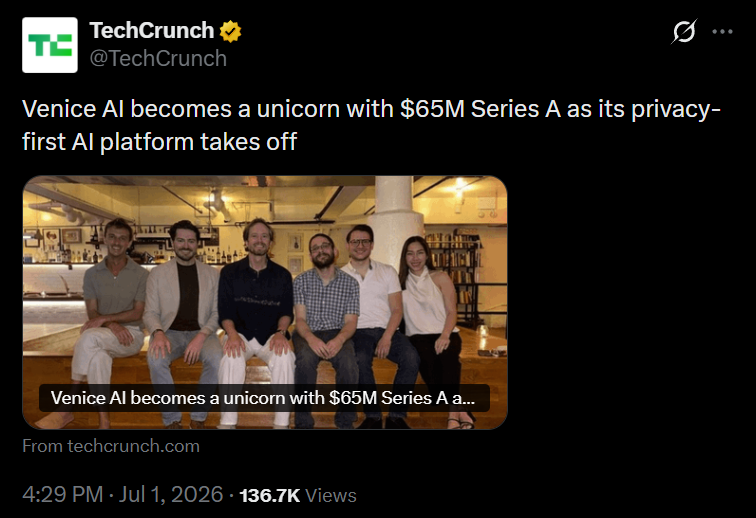
On July 1, 2026, Venice AI announced a $65 million Series A. The round was led by Dragonfly, with participation from Coinbase Ventures, F-Prime, North Island Ventures, Archetype, Liquid2 Ventures, and Morgan Creek, among others. Venice itself refers to this as its first external capital raise, boasting a $1 billion valuation.
The news is fundamentally more relevant than it initially appears, as it elevates Venice from an interesting crypto-AI experiment to a venture-backed AI company with a genuine revenue and user base.
The structure is crucial here. Venice did not simply dump VVV tokens on the open market to raise funds. Voorhees stated that they deliberately sold equity. In exchange, investors received an 8.98% equity stake, alongside 1.5 million VVV as a vesting grant and warrants for an additional 5 million VVV exercisable over eight years. To exercise these warrants, investors would need to pay another $66.5 million roughly; upon full exercise, the total capital raised would thus swell to approximately $131.5 million.
Why This Matters for VVV
The most important takeaway is this: Venice raised capital without directly selling its treasury tokens. This is bullish for token holders because it prevents an immediate treasury dump. According to Voorhees, Venice continues to hold over 30 million VVV out of a slightly more than 80 million total supply, and purportedly neither the company nor the team has sold any VVV to date.
The catch lies in future dilution. The token allocations to investors are locked for a year, subject to a 12-month cliff, and vest linearly over three years thereafter. If all warrants are exercised, an average of roughly 6,000 additional VVV per day could enter the circulating supply starting around July 2027. Voorhees frames this as negligible, representing roughly 0.2% of current daily volume. While not a short-term shock, it is a clear factor for any long-term tokenomics assessment.
Before we continue: this is exactly the type of situation where surface-level crypto commentary tends to fail.
A funding round is easy to celebrate. The harder part is understanding who actually captures the value: the company, the token, the users, or the investors sitting one layer closer to the economics.
That is the work we do inside the Proof Of Analysis membership.
For $29, members get access to our growing research library: deeper coin analysis, sector breakdowns, narrative assessments, market structure, and institutional-grade research on areas such as AI, RWA, privacy, and emerging crypto infrastructure.
If you want the deeper research layer behind notes like this, join the membership here:
Get Full Access for $29:
The True Substance of the News
Venice is now claiming remarkable operational metrics: 3.5 million registered users, 1.3 trillion tokens processed per month, roughly 2 million API calls per day, and a peak load of 300,000 inference requests per hour. Additionally, Venice reports that 33.7 million VVV—approximately 42% of the supply—have already been burned, and annual emissions are decreasing from 4 million to 3 million VVV.
TechCrunch adds what is likely the most critical business metric: Venice is reportedly already profitable and boasts an annualized revenue run rate (ARR) exceeding $70 million. At a $1 billion valuation, this roughly translates to a 14x ARR multiple, which does not appear absurd for a profitable, rapidly growing AI consumer/API enterprise.
Use of Funds
The capital is earmarked primarily for scaling, GPU capacity, and proprietary compute infrastructure. Venice intends to build its own data center infrastructure to reduce reliance on rented GPUs. This is crucial for VVV, because higher gross margins theoretically enable more aggressive buyback-and-burn programs.
Our Assessment
For VVV, this is clearly bullish, but not naively bullish.
Bullish because Venice can now demonstrate three things simultaneously: real users, real revenue, and real institutional capital. This elevates VVV out of the usual AI token soup. Most AI coins sell a network narrative before a product even exists. Venice has a product, traction, and revenue, and only subsequently took VC money. That exact sequence is rare.
The second positive point is the capital structure. Venice sold equity and preserved its VVV treasury. This signals that Voorhees is treating the token as a long-term strategic resource, not an ATM.
The third point is the compute logic. If Venice builds out its own GPUs and data center capacity, VVV can transition more heavily into a claim on usable AI inference. VVV would then be less of a meme, less of a governance decoration, and more of a product-bound access key.
The critical friction point remains the equity/token split. The $1 billion valuation belongs to the Venice AI corporate entity. VVV holders do not own equity. Their value hinges on whether Venice actually translates its revenues into token demand via staking, DIEM, buybacks, burns, and inference access. This is exactly where it will be decided whether VVV becomes a genuine value-capture asset or simply a very well-narrated proxy for Venice.ai.
Currently, VVV is trading around $13.41, with a market cap of roughly $633 million and a circulating supply of approximately 47 million VVV.
Conclusion
The news significantly improves the fundamental case for VVV. It confirms product-market fit, institutional credibility, operational scaling, and a token-preserving financing round. The most crucial litmus test now is whether Venice translates this new funding into more revenue, better margins, larger burns, and genuinely rising VVV staking demand.
Our short assessment: strongly positive for the fundamental score, but not a blind "buy the news" post-pump. High on the watchlist, favoring accumulation on pullbacks rather than chasing euphoric green candles.
Final Note ;)
VVV is not interesting because it has discovered the fashionable art of attaching “AI” to a token ticker. That part, regrettably, is not rare.
It is interesting because there may be a real business underneath the token narrative — revenue, users, infrastructure demand, and a potential mechanism for token-linked value capture.
The distinction matters.
Funding validates a business more directly than it validates the associated token. Our complete Venice AI Deep Dive examines VVV utility, staking, DIEM economics, inference demand, supply risk, value capture and the conditions required for platform growth to reach token holders.
See you beyond the narrative layer,
The Research Desk