POA Newsletter 33/2026 - The Market Is Waiting for Permission
Crypto recovered without euphoria as ETF inflows surged and US employment weakened. CPI now decides whether the setup becomes genuinely bullish.


ETF money returned. The labor market weakened. Now inflation decides whether crypto gets a clean macro tailwind — or a stagflation problem.
Week of August 10–16, 2026
There are weeks when crypto moves because something happened, and there are weeks when the interesting part is that almost nothing happened to price despite quite a lot happening underneath it. The week just ended belongs to the second category.
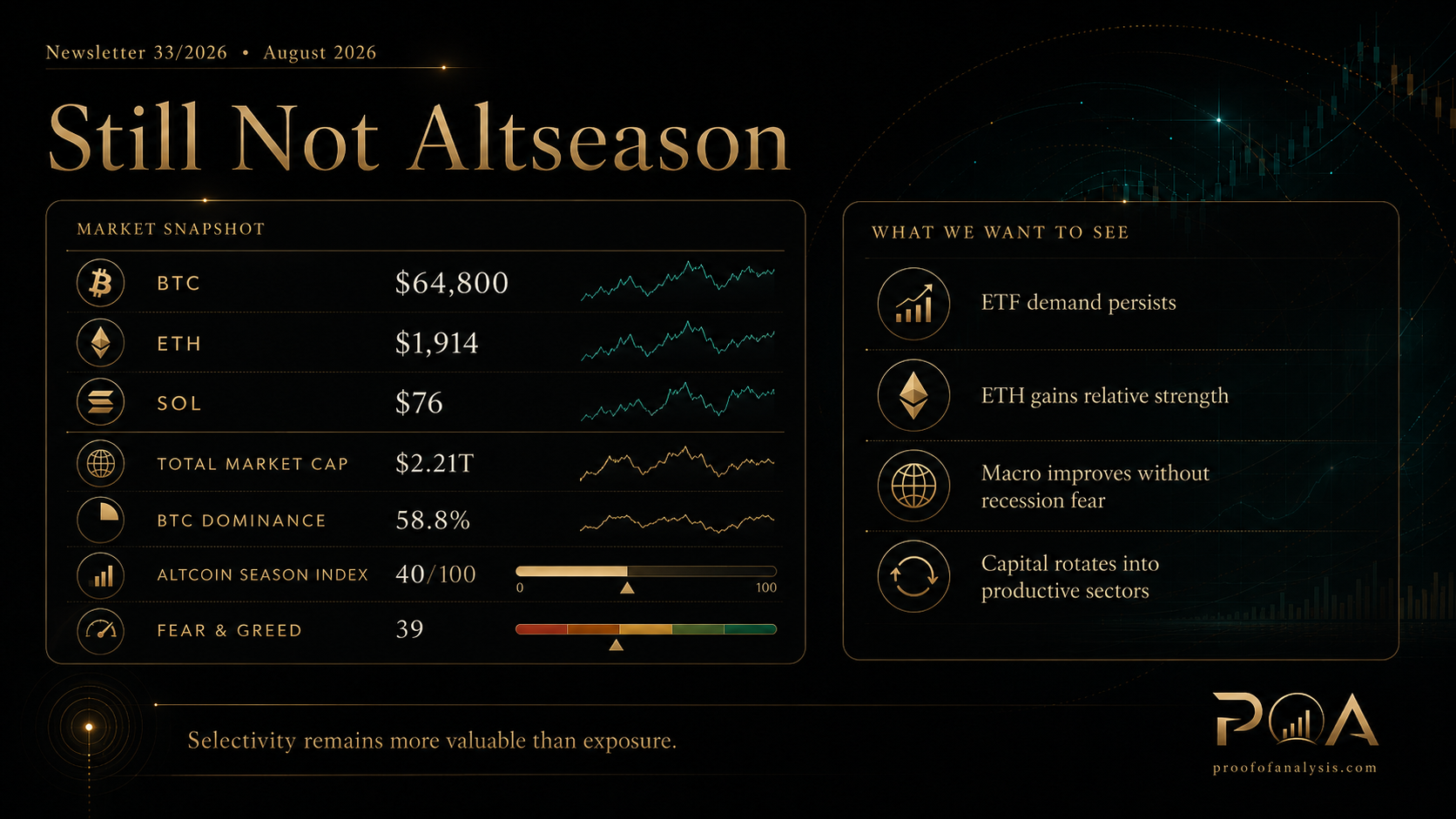
Bitcoin began August struggling around $63,000 and finishes the week near $64,800. Ethereum is around $1,914, Solana around $76, and the total crypto market capitalization sits near $2.21 trillion. Bitcoin dominance remains elevated at 58.8%, while CoinMarketCap's Altcoin Season Index is only 40/100 and Fear & Greed sits at 39.
In other words: Prices improved. Sentiment did not. We think that is more interesting than another euphoric 10% candle. Because beneath an otherwise uneventful week, three things changed.
Institutional flows turned significantly better. The US labor market suddenly looked considerably weaker. And Washington failed to deliver its long-awaited crypto market structure law — but importantly, did not kill it either.
Next week, all three stories run into one macroeconomic obstacle: inflation.
Last week: a rebound without conviction
Bitcoin gained roughly 3% over the week, with ETH and SOL also recovering a few percentage points from Monday levels. Bitcoin's move was enough to produce its first positive week in three weeks, but not enough to break the broader post-2025 downtrend.
That sounds mediocre. We would describe it differently: The market absorbed weak sentiment without producing another leg down. There is a difference.
Crypto remains nowhere close to an obvious speculative mania. BTC is still almost 49% below its October 2025 all-time high, ETH is more than 60% below its peak, and SOL roughly 74% below its January 2025 high. Yet institutional flows suddenly became much better.
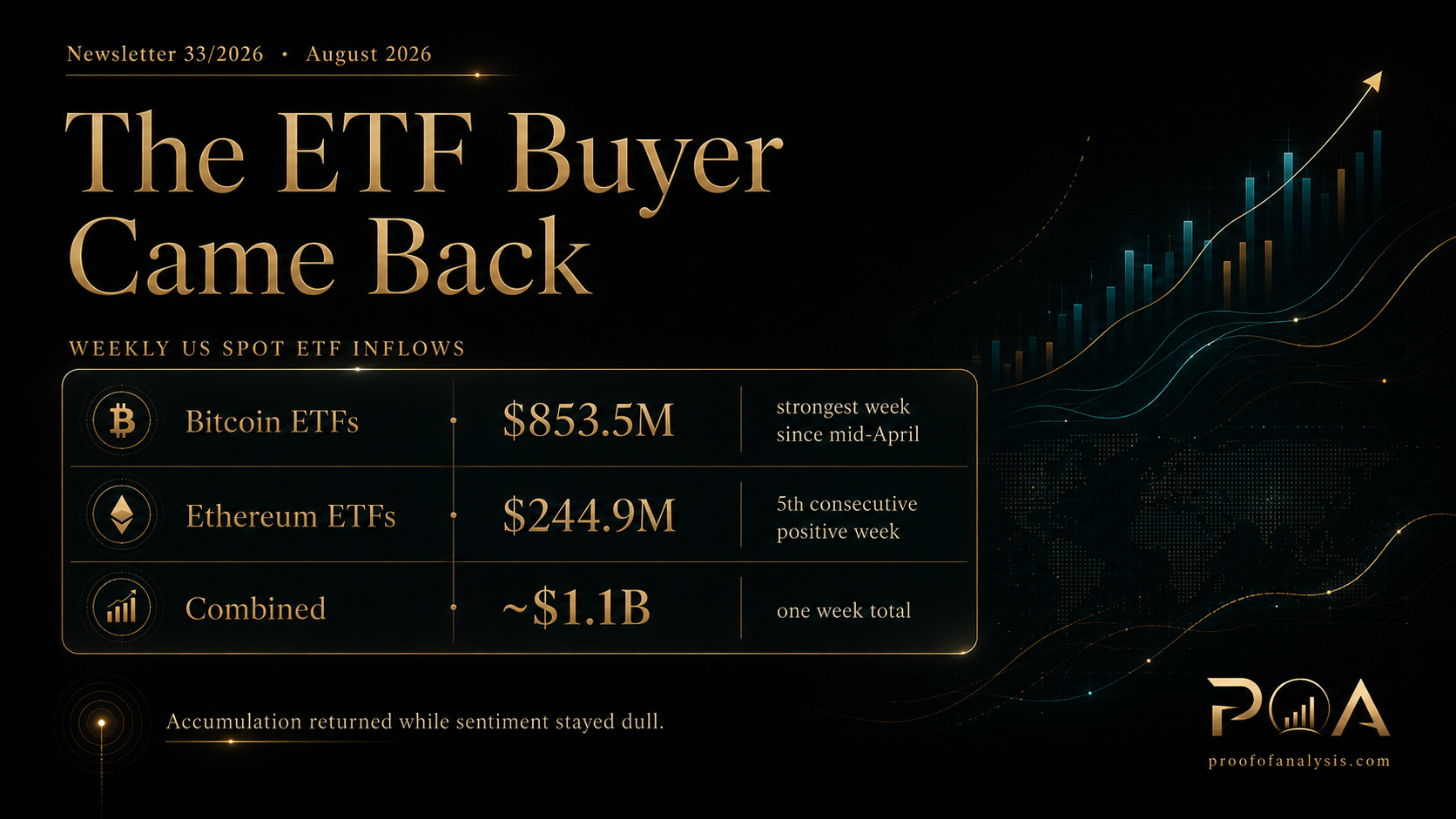
The ETF buyer came back
US spot Bitcoin ETFs attracted approximately $853.5 million during the week, their strongest weekly inflow since mid-April and a five-session streak of positive flows.
Ethereum ETFs added another $244.9 million, their fifth consecutive positive week.
Combined:
And it happened despite subdued trading volumes - that last part matters.
A speculative rally accompanied by enormous leverage and exploding volumes tells us people are chasing price. Steady ETF accumulation while the market is dull tells us something different: someone is willing to own the asset even when owning it is boring.
We prefer the second signal.
There is an important caveat. The recent rebound has not repaired 2026 as a whole. As recently as late July, Bitcoin ETFs remained roughly $5.2 billion net negative for the year, with Ether ETFs also still underwater year-to-date. So this is not yet a structural reversal. It is the first evidence worth watching for one.
Then the labor market cracked
Friday supplied the week's most important macro number. US nonfarm payroll employment fell by 23,000 in July. The unemployment rate was 4.1%, while average hourly earnings barely moved during the month and were up 3.2% year-on-year. That matters because the Federal Reserve only recently left rates unchanged at 3.50–3.75%.
The macro equation has therefore become considerably more interesting. For much of the cycle, crypto wanted weaker economic data because weaker growth meant easier monetary policy. But there is a limit. A slightly weaker labor market is good for duration assets. A collapsing labor market is not. And a weakening labor market combined with renewed inflation is the worst combination of all. That is why next Wednesday matters more than Friday did.
Next week: CPI becomes the referee
The US releases July CPI on Wednesday, August 12, followed by PPI on Thursday, August 13 and July retail sales on Friday, August 14.
The setup is unusually clear because June inflation was weak: headline CPI actually fell 0.4% month-on-month in June.

That gives us three broad scenarios.
Scenario 1: Soft CPI + weak labor market
This is the clearest crypto outcome.
Inflation remains contained while employment deteriorates. The Fed gains substantially more room to ease policy at coming meetings without appearing to abandon price stability.
Long-duration and risk assets should like it. Crypto should like it even more.
Scenario 2: Hot CPI + weak labor market
This is the ugly one.
Growth deteriorates while inflation returns. The market cannot comfortably price aggressive easing because the Fed's inflation mandate remains active, but it cannot celebrate economic strength either.
That combination would challenge the simple liquidity-driven crypto bull case.
Scenario 3: Hot CPI + strong retail sales
Probably less damaging.
It would imply that the economy still has enough nominal momentum to tolerate restrictive monetary policy. Rates might remain higher for longer, but the market would at least avoid the more dangerous stagflation narrative.
The important point is that Wednesday's CPI number should not be read in isolation anymore.
After Friday's −23,000 payroll print, every inflation number is now also a growth number.
Washington: delayed, not dead
The other major development last week happened in Washington. The Senate did not complete comprehensive crypto market-structure legislation before leaving for its August recess. That is disappointing.
But Senate Majority Leader John Thune filed a cloture motion before the break, setting up procedural action when the Senate returns, with September 15 now the important date. The legislation would establish clearer divisions between securities and commodities and formalize the respective roles of the SEC and CFTC.
We therefore would not describe the CLARITY story as a failure, we would describe it as a catalyst deferred by five weeks.
There are still substantial disagreements — including stablecoin rewards, banking competition and political ethics provisions — so passage is by no means guaranteed. But regulatory clarity remains one of the few potential catalysts capable of affecting the valuation framework of the entire altcoin market rather than merely one protocol. September 15 belongs on the calendar.
The hidden risk next week: supply
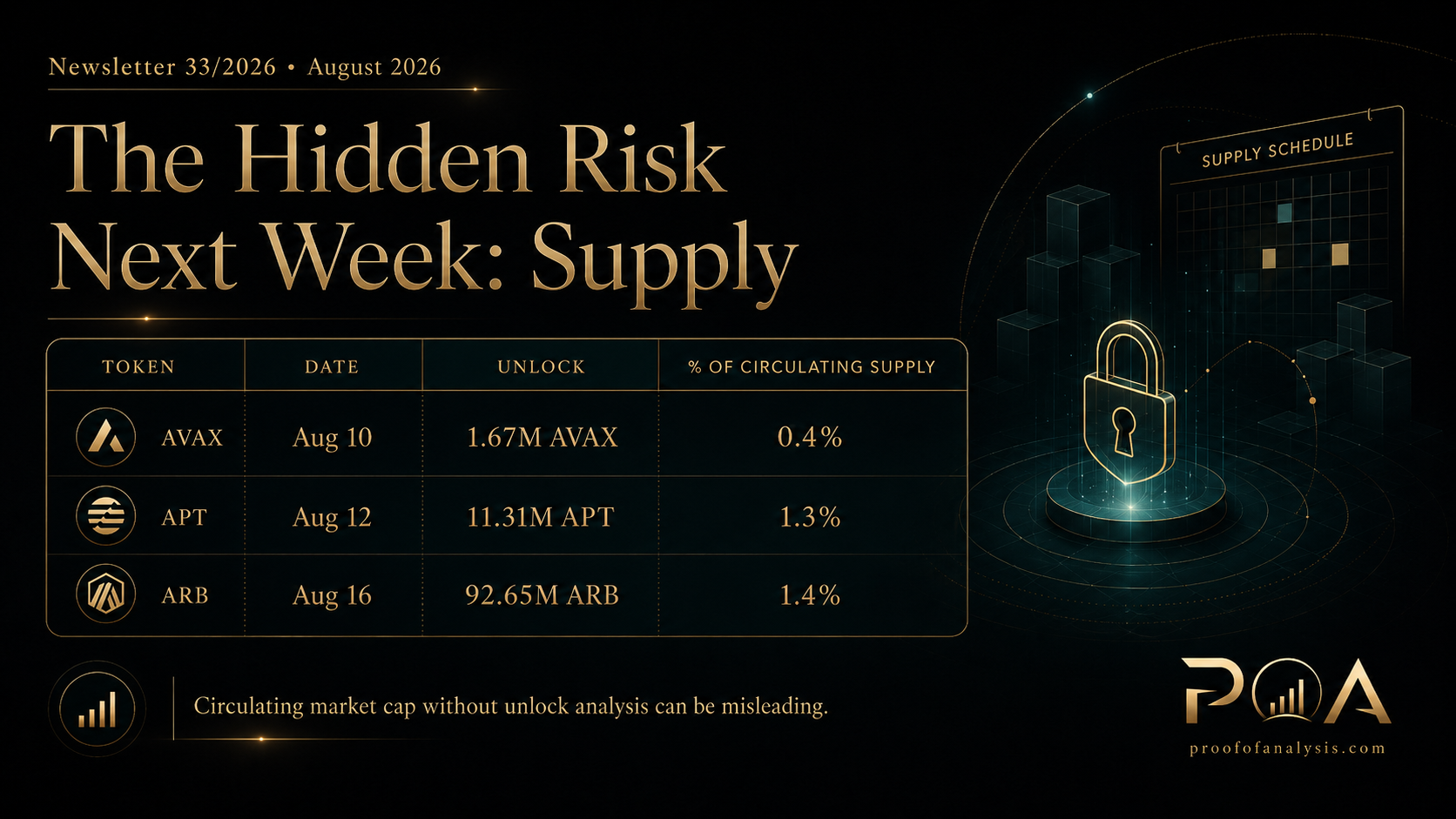
Macro will dominate headlines. Supply will quietly matter underneath them. Three large-cap tokens face scheduled unlocks next week.
Avalanche — August 10
Tokenomist lists the next AVAX unlock for August 10, allocated to the Avalanche Foundation. Market data indicate approximately 1.67 million AVAX, equivalent to roughly 0.4% of current circulating supply. Not catastrophic, but worth knowing.
Aptos — August 12
APT unlocks approximately 11.31 million tokens on August 12. Against the current circulating supply of roughly 846 million APT, that represents about 1.3% additional circulating supply.
More meaningful, and inconveniently scheduled for the same day as CPI.
Arbitrum — August 16
ARB's recurring monthly vesting continues with approximately 92.65 million ARB due in mid-August, equivalent to around 1.4% of current circulating supply. The releases include team/advisor and investor allocations.
Some tokens spend years attempting to grow demand while a contractual supply schedule continuously works in the opposite direction.
It is one reason POA increasingly treats circulating market cap without unlock analysis as an almost meaningless valuation metric.
No, this is still not altseason
Bitcoin dominance sits at 58.8%. CoinMarketCap's Altcoin Season Index reads 40/100 — firmly short of an altseason regime.
We think this accurately describes the market. There are attractive individual altcoins, there are excellent infrastructure projects, there are absurdly cheap-looking tokens, and there are also hundreds of assets down 80–95% whose holders have spent the past year explaining why this makes them even more undervalued. Those are not the same thing.
The next sustainable altcoin rotation will need more than Bitcoin stabilizing for several days.
We want to see:
- ETF demand persist rather than disappear after one strong week.
- ETH begin gaining relative strength rather than merely following BTC upward.
- Macro conditions become supportive without signalling recession.
- Capital spread into fundamentally productive sectors rather than simply the lowest-quality high-beta coins.
Until then, selectivity remains more valuable than exposure.
What we are watching
Our framework for the coming week is unusually simple.
Bitcoin
BTC near $65,000 is neither cheap enough to make price irrelevant nor strong enough to declare a new trend. What matters is whether ETF inflows continue while Bitcoin stops requiring bad economic news to rise. That would be healthier.
Ethereum
ETH ETF inflows deserve attention. Five consecutive positive weeks are beginning to look different from a one-week tactical rotation. The more important question is whether capital entering ETH products eventually translates into relative strength against Bitcoin. That has not yet been convincingly demonstrated.
Solana
SOL remains the most obvious large-cap higher-beta alternative to BTC and ETH, but its roughly $44 billion current market capitalization means the easy “cheap alternative L1” argument has long disappeared.
We continue to prefer evaluating Solana through actual application economics, stablecoin activity, DEX/perps demand and fee capture rather than TPS headlines.
Altcoins generally
This is not the week to buy something because CPI might be good. It is the week to know exactly which assets you want if macro conditions improve. There is a difference.
The POA view
Our base case entering August 10–16 is modestly constructive. Not bullish enough to chase, not bearish enough to hide.
The market just received three useful pieces of information:
Institutional crypto demand improved.
The US labor market weakened.
Crypto legislation remains alive.
The missing variable is inflation.
If July CPI confirms that inflation remains under control, the market will suddenly have a much cleaner narrative:
weaker employment + contained inflation + returning ETF flows + an approaching September Fed meeting.
That is the kind of environment in which crypto can reprice quickly. If CPI surprises badly to the upside, however, Friday's weak jobs report stops being bullish. It becomes evidence of a much less comfortable economy. So the most important crypto event next week is not a mainnet launch, but it happens Wednesday morning in Washington.
Bottom line
Last week: institutional flows improved faster than price.
This week: macro data decide whether price catches up.
Our stance: cautiously constructive, still selective.
The signal we want: another week of ETF inflows accompanied by benign inflation.
The signal we do not want: hot CPI combined with weak growth.
The mistake to avoid: interpreting every beaten-down altcoin as a leveraged bet on better macro conditions.
There will eventually be another broad crypto risk-on period. Our job is not to own everything before it happens. Our job is to make sure that when liquidity returns, we already know which assets deserve it.