Newsletter 32/26: The Week UNI Became More Than a Governance Token
Uniswap’s first v4 fee controller is live across seven chains. We examine what changed for UNI, what the bulls are missing and the market events that matter next.

Uniswap switched on v4 protocol fees, liquidity remained selective, and August opened with a crowded calendar of unlocks and macro risk.
Proof of Analysis Weekly
Crypto has spent years producing successful protocols attached to economically useless tokens.
The product attracts users. Traders pay fees. Developers build integrations. Market makers provide liquidity. The protocol becomes important — and the tokenholder receives governance rights over a machine that sends its money somewhere else.
Uniswap was the perfect example. It processed trillions of dollars in cumulative volume and became core infrastructure for Ethereum, yet UNI remained largely a bet on future governance decisions. Holders governed one of crypto’s most successful applications without participating meaningfully in its economics.
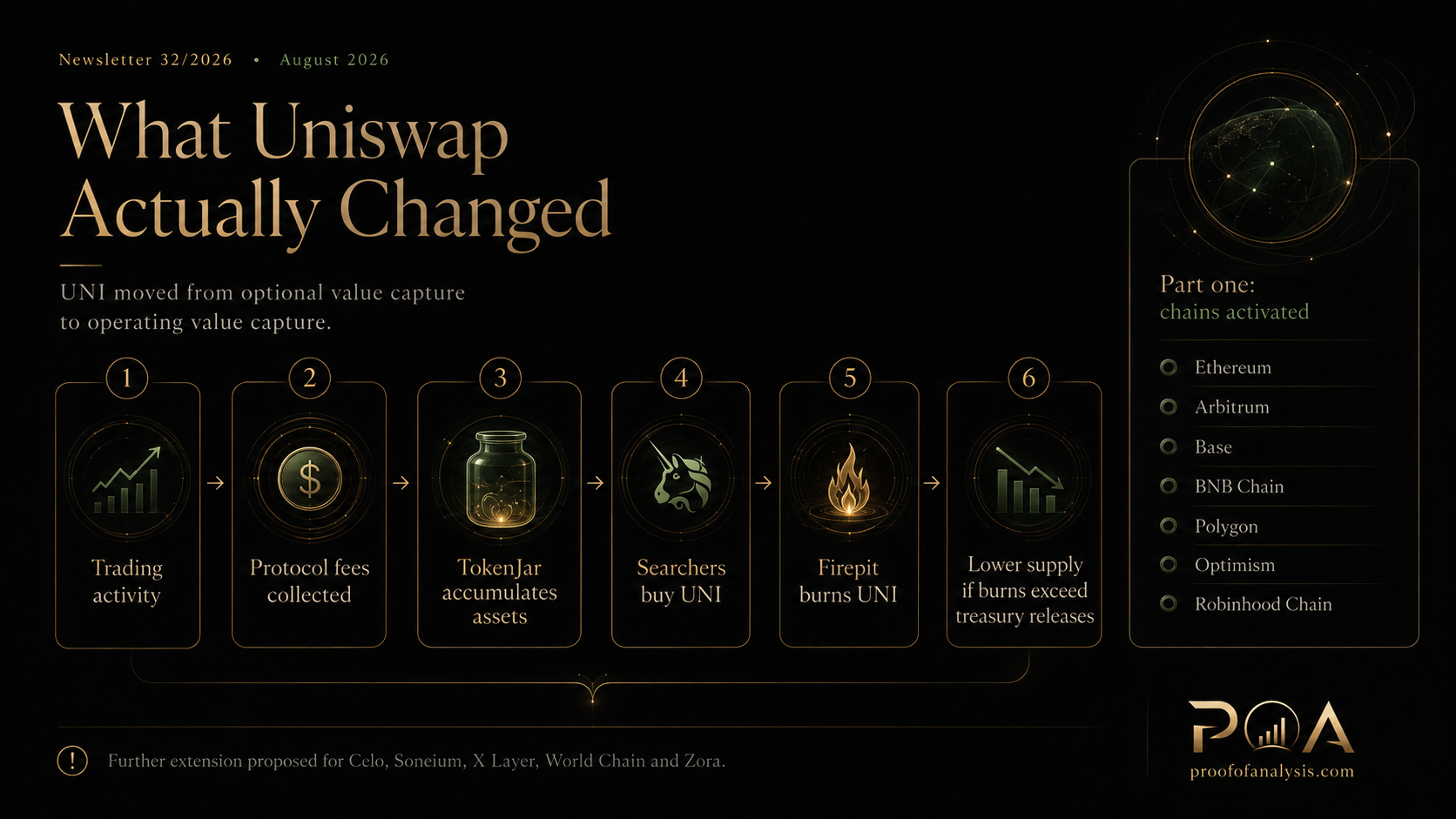
That changed this week. The first Uniswap v4 protocol-fee proposal was executed onchain on July 27. It activated the fee controller across seven chains: Ethereum, Arbitrum, Base, BNB Chain, Polygon, Optimism and Robinhood Chain.
The distinction is important. Crypto is full of proposals, roadmaps and votes. This one has moved into execution.
Uniswap usage can now generate fees that accumulate in TokenJar contracts. External searchers exchange UNI for those accumulated assets, and the UNI is permanently burned through the Firepit mechanism. The process connects protocol activity to token scarcity without promising a dividend or direct distribution.
UNI is no longer only a governance token. It is not equity either. That uncomfortable space between the two is where this week’s newsletter begins.
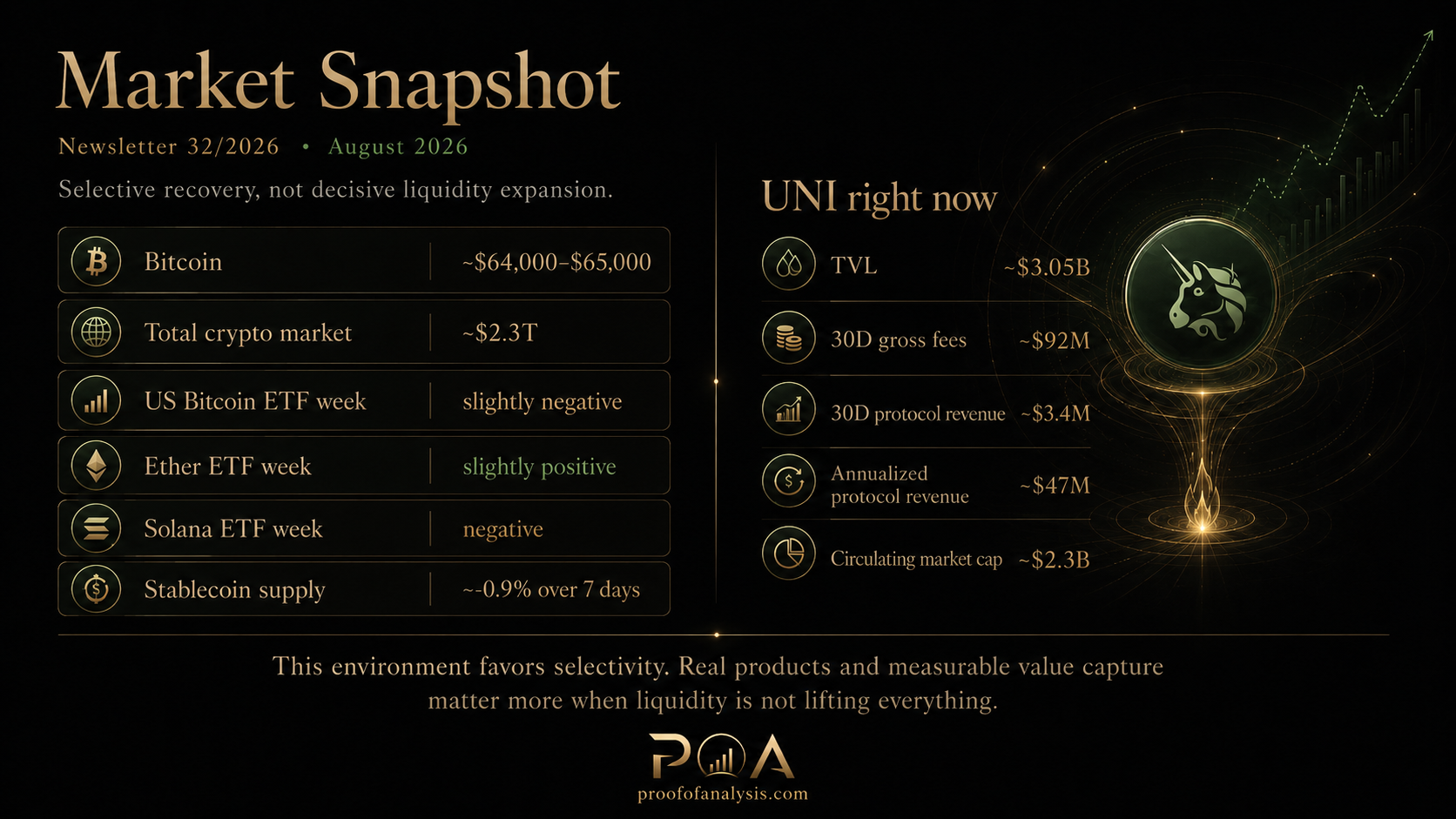
The broader market is recovering selectively rather than decisively. Bitcoin trades near $64,000–$65,000, Ethereum has shown better relative strength over the past month, and the total crypto market is around $2.3 trillion. But the latest completed ETF week remained mixed: US Bitcoin funds finished slightly negative on balance, Ether funds slightly positive and Solana funds negative. Stablecoin supply also contracted by roughly 0.9% over seven days.
This is not the profile of a broad liquidity expansion. Capital is moving between assets, but there is limited evidence that large amounts of new crypto-native purchasing power are entering the system.
That environment favours selectivity. Real products and measurable value capture matter more when liquidity is not lifting everything at once.
The current fee architecture began with the UNIfication proposal approved in late 2025.
The framework activated protocol fees, introduced the UNI-burn mechanism, directed eligible Unichain sequencer fees toward the same system and destroyed 100 million treasury UNI as a retroactive burn. It also approved a two-year, 40 million UNI growth budget for Uniswap Labs and the wider ecosystem.
Fees subsequently expanded across v2 and v3 deployments on eleven chains. v4 was the remaining gap: Uniswap’s newest and most programmable protocol generation was producing activity without participating fully in the burn system. The July execution begins closing that gap.
v4 is more complicated than previous versions because developers can attach hooks that alter pool behaviour. A single universal fee rule would not work across every possible configuration. The new controller therefore activates fees for defined pool families while allowing governance to change policies and make exceptions.
Part one covers seven chains. Another proposal is intended to extend the system to Celo, Soneium, X Layer, World Chain and Zora. This is a measured rollout rather than a universal switch. That is probably wise. It also means headlines claiming that “all v4 fees now burn UNI” would be inaccurate.
The good news for UNI holders
The most important improvement is conceptual simplicity.
Before the fee switch, the bull case required investors to believe that Uniswap’s success would eventually become relevant to UNI. Now there is an observable bridge between product use and token supply.
Uniswap currently reports approximately $3.05 billion in TVL. Over the latest 30-day window, the protocol produced about $92 million in gross fees and approximately $3.4 million in protocol revenue. The trailing annualized protocol-revenue estimate is around $47 million.
Those numbers are not enormous relative to UNI’s roughly $2.3 billion circulating market capitalization. They are nevertheless qualitatively different from zero.
UNI holders can now monitor:
protocol fees collected across chains;
assets accumulated in TokenJar;
UNI delivered by searchers;
tokens sent permanently to the burn address;
treasury distributions that offset those burns.
That is far better than valuing a token through vague concepts such as “governance premium” or “ecosystem importance.”
The system also offers future expansion paths. Unichain sequencer fees can enter the burn. Protocol Fee Discount Auctions are designed to internalize part of the MEV currently captured by searchers and validators. Aggregator hooks could allow Uniswap to route external liquidity while still creating UNI-linked revenue.
None of those future sources should be treated as established cashflow today. But the architecture now exists.
Turning on fees does not create free money. It changes who receives money already generated by trading.
Most Uniswap fees compensate liquidity providers. Protocol fees reduce that compensation and redirect part of it toward UNI burns. If competing venues offer similar execution while paying LPs more, capital can migrate. Lower liquidity can produce worse prices, which can send traders and aggregators elsewhere.
In the worst case, UNI holders receive a larger share of a shrinking network.
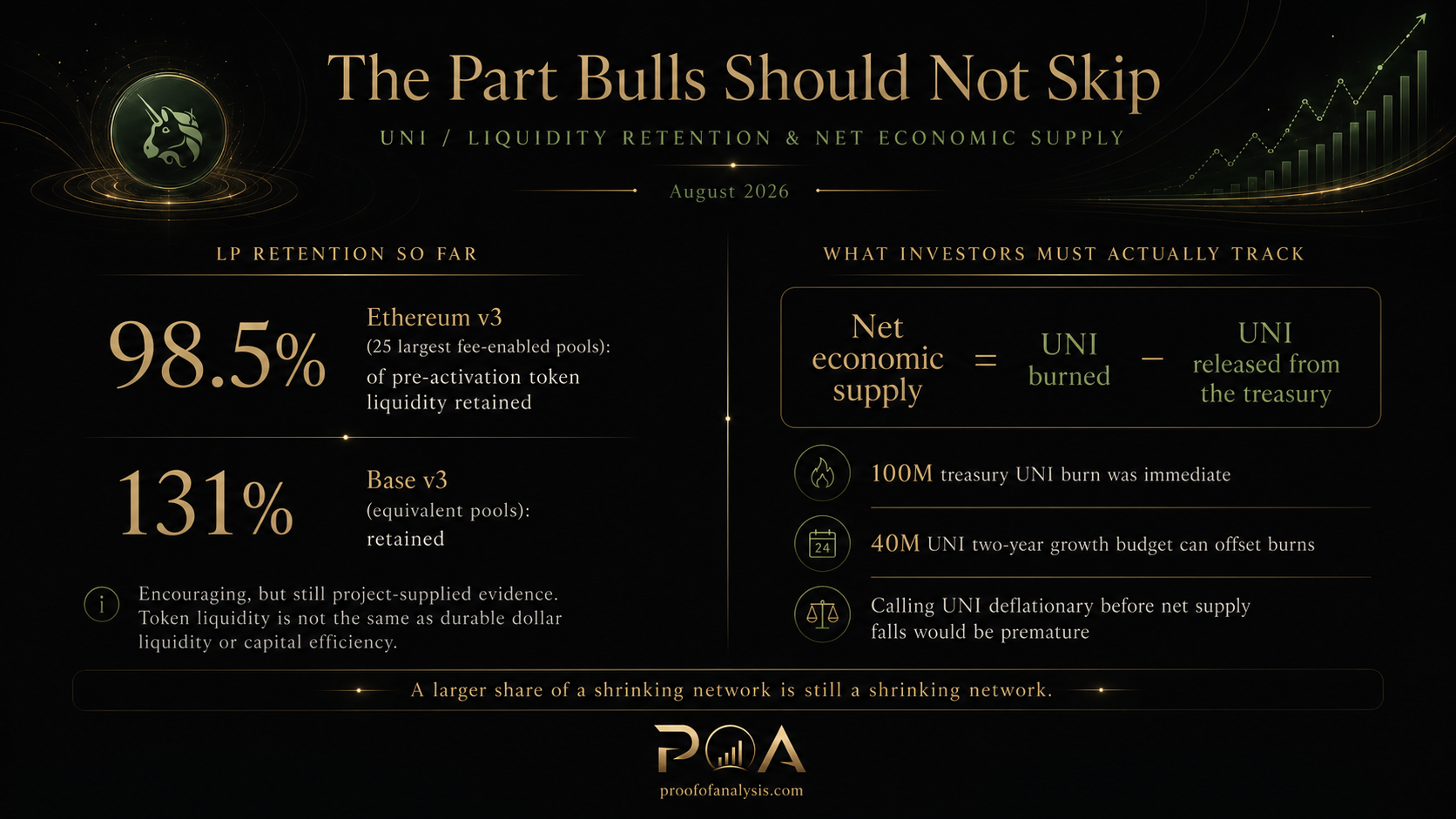
Uniswap Labs says the gradual v2/v3 rollout has not caused a meaningful exodus. According to its July governance response, the 25 largest fee-enabled v3 pools on Ethereum retained 98.5% of their pre-activation token liquidity, while the equivalent Base pools held 131%.
That is encouraging, but it is still project-supplied evidence. Token-denominated liquidity does not perfectly measure dollar liquidity, active ranges or capital efficiency. The true test will take several quarters.
There is another complication: the 40 million UNI growth budget.
The 100 million treasury burn was immediate and visually impressive. But tokens distributed from the treasury become economically available even if they are not newly minted. Investors should therefore ignore gross burn and track net economic supply:
UNI burned minus UNI released from the treasury.
If burns remove five million tokens while ecosystem spending introduces twenty million, effective market supply still rises.
Calling UNI “deflationary” before this number remains negative would be premature.
A strange revenue month
The latest fee data also contain an anomaly. Robinhood Chain contributed more than $56 million of Uniswap’s roughly $92 million in 30-day gross fees. That is an extraordinary share for a new chain and reflects intense launch-period activity.
It may become a durable distribution channel. It may also prove to be a temporary burst of speculation.
This matters because annualizing a launch month can create absurd valuations. The correct questions are not simply how much volume occurred, but:
How many users return?
How much activity remains after incentives and novelty fade?
Which pools generated the fees?
How much became protocol revenue?
How much UNI was ultimately burned?
The market will probably focus on the headline volume. We are more interested in retention.
What this means for UNI
Our full POA assessment now places Uniswap at 88/100, with a HOLD verdict, STRONG portfolio fit and Research Confidence of 96/100.
That does not mean the token is automatically cheap. At the current market capitalization, UNI trades at roughly 50–60 times present annualized protocol revenue, depending on the measurement window. Investors are already paying for substantial growth from v4, Unichain and additional fee sources.
The fundamental change is more basic:
UNI has moved from optional value capture to operating value capture.
That makes it one of the strongest large-cap DeFi assets. It also raises the standard by which it should be judged. From here, announcements matter less. Revenue, retained liquidity and net burns matter more.
SUI supply enters the market
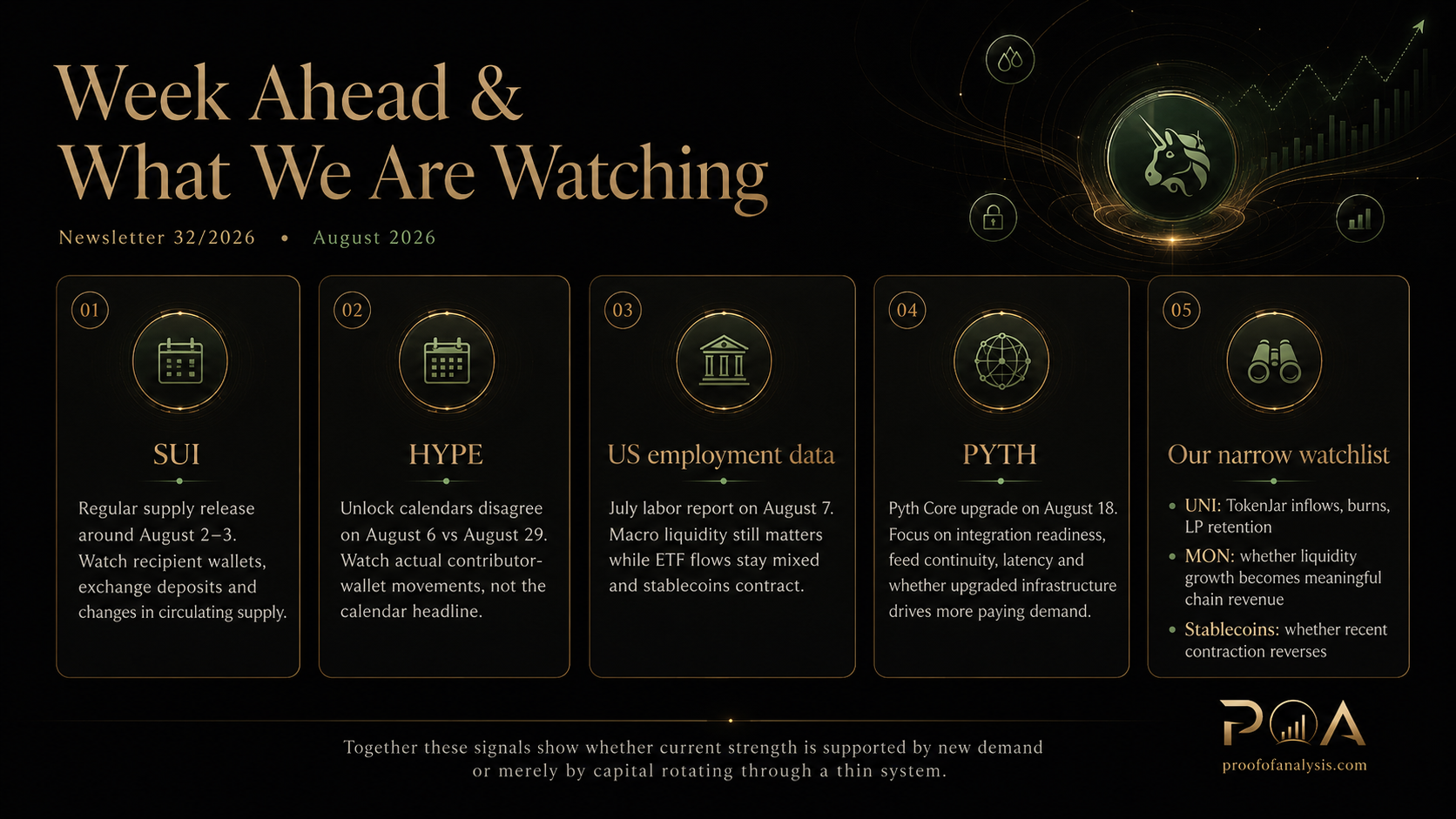
The regular SUI release falls around August 2–3, although secondary calendars disagree slightly on timing and classification. Rather than reacting to the calendar alone, we will watch recipient wallets, exchange deposits and the change in circulating supply.
SUI remains a technically strong network with a weaker long-term dilution profile. A smoothly absorbed release would be positive evidence, not a reason by itself to upgrade the thesis.
HYPE’s disputed unlock date
One data provider lists August 6 as the next contributor release. Another lists August 29.
This disagreement is a useful reminder that unlock calendars are discovery tools, not settlement layers. Vesting, claimability, actual transfer and circulating supply are different events.
We will check contributor-wallet movements on August 6 rather than pretending the calendar is definitive.
US employment data
The July US employment report arrives on August 7. A strong labour market would support the case for persistently restrictive monetary policy. A weaker report could help liquidity expectations, unless the deterioration is severe enough to revive recession concerns.
With stablecoin supply contracting and ETF flows mixed, macro liquidity still matters more than crypto would like to admit.
Pyth’s infrastructure test approaches
Pyth Core is scheduled to upgrade on August 18. Hermes users will need API keys, most onchain contracts will be upgraded automatically and Sui integrations require manual migration.
This is more than a routine software release. Pyth sits inside the pricing infrastructure of many DeFi applications. The relevant questions are integration readiness, feed continuity, latency, new central dependencies and whether the upgraded system eventually produces more paying demand for PYTH.
What we are watching
The market does not currently reward indiscriminate exposure. Our focus this week is therefore narrow:
UNI: real v4 TokenJar inflows, burns and LP retention.
HYPE: actual wallet movements rather than disputed unlock calendars.
SUI: supply absorption and exchange deposits.
MON: whether liquidity growth produces meaningful chain revenue.
Stablecoins: whether the recent contraction reverses.
No single item guarantees a market move. Together, they tell us whether current strength is supported by new demand or merely by capital rotating through a thin system.
Final view
Uniswap’s fee switch is one of the more important token-economic developments of the year because it resolves a long-standing contradiction.
The protocol was successful. The token was mostly optionality. Now usage can reduce UNI supply through an operating, onchain mechanism.
That does not transform UNI into a share of Uniswap Labs. It does not guarantee that burns exceed treasury spending. It does not prove that LPs will tolerate the fee indefinitely. And it certainly does not make valuation irrelevant. But it gives investors something crypto governance tokens rarely provide: a mechanism that can be observed, measured and falsified.
The old UNI thesis was based on hope that value capture would arrive. The new thesis is based on whether the value capture that arrived is large enough — and sustainable enough — to matter. That is progress.