The POA AI Portfolio

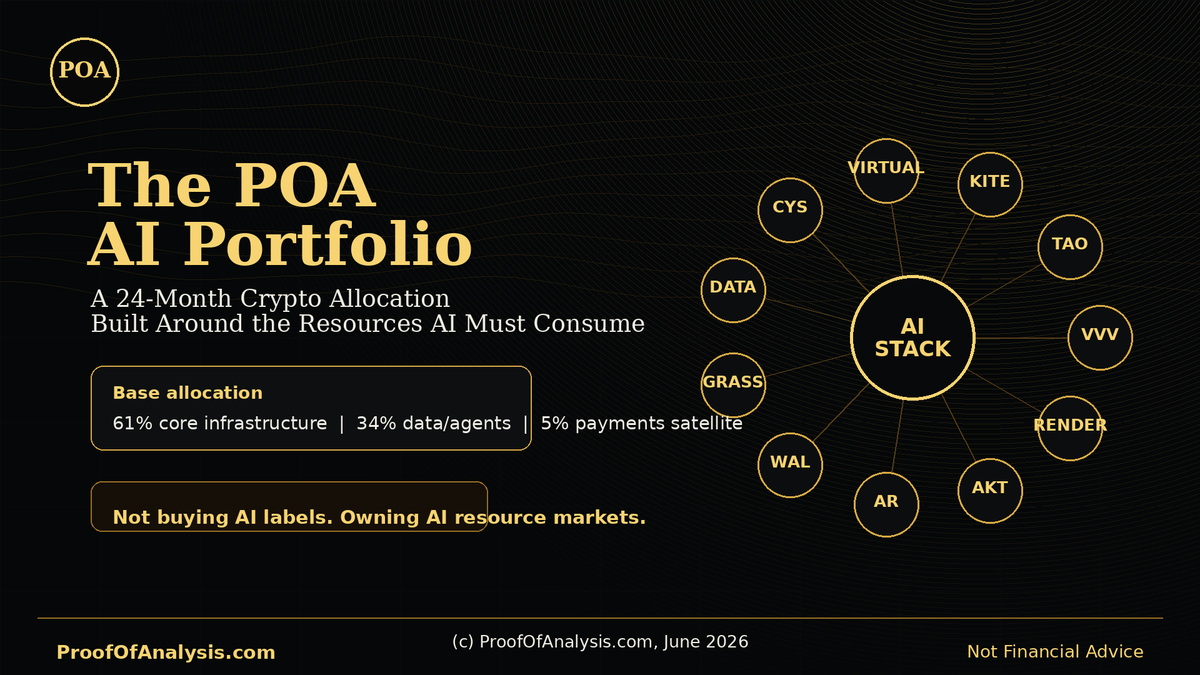
Most AI crypto portfolios chase the agent narrative. Our 24-month allocation focuses on the resources AI systems must consume: inference, compute, storage, data, provenance, coordination, payments and evaluation.


Share
The POA AI Portfolio

A 24-month allocation across private inference, compute, storage, data, verifiable infrastructure, agent economies and agent payments.

Not Financial Advice.

The AI crypto market has entered its second phase.

The first phase was simple. Anything with an AI label could attract attention. A chatbot became an agent. A dashboard became intelligence infrastructure. A terminal became DeFAI. A token with a prompt box became a category.

That phase was useful, but not because it produced much quality. It forced the market to reveal what it actually believes AI crypto is.

Most of the market still treats AI crypto as a bag of agent coins. We do not. Our view is that the correct AI crypto portfolio is not built around the face of the agent economy. It is built around the resources that AI systems must consume: inference, compute, storage, data, provenance, coordination, payments, and evaluation.

That distinction matters because the AI category has become crowded to the point of absurdity. CoinGecko reported that Artificial Intelligence had become the second-most listed crypto category by May 2026, reaching 1,798 coins, up from only 145 at the start of 2024. That is not diversification. That is landfill expansion with better branding.

The task, therefore, is not to own “AI.” The task is to own the scarce economic points inside the AI stack.


The portfolio by AI resource layer
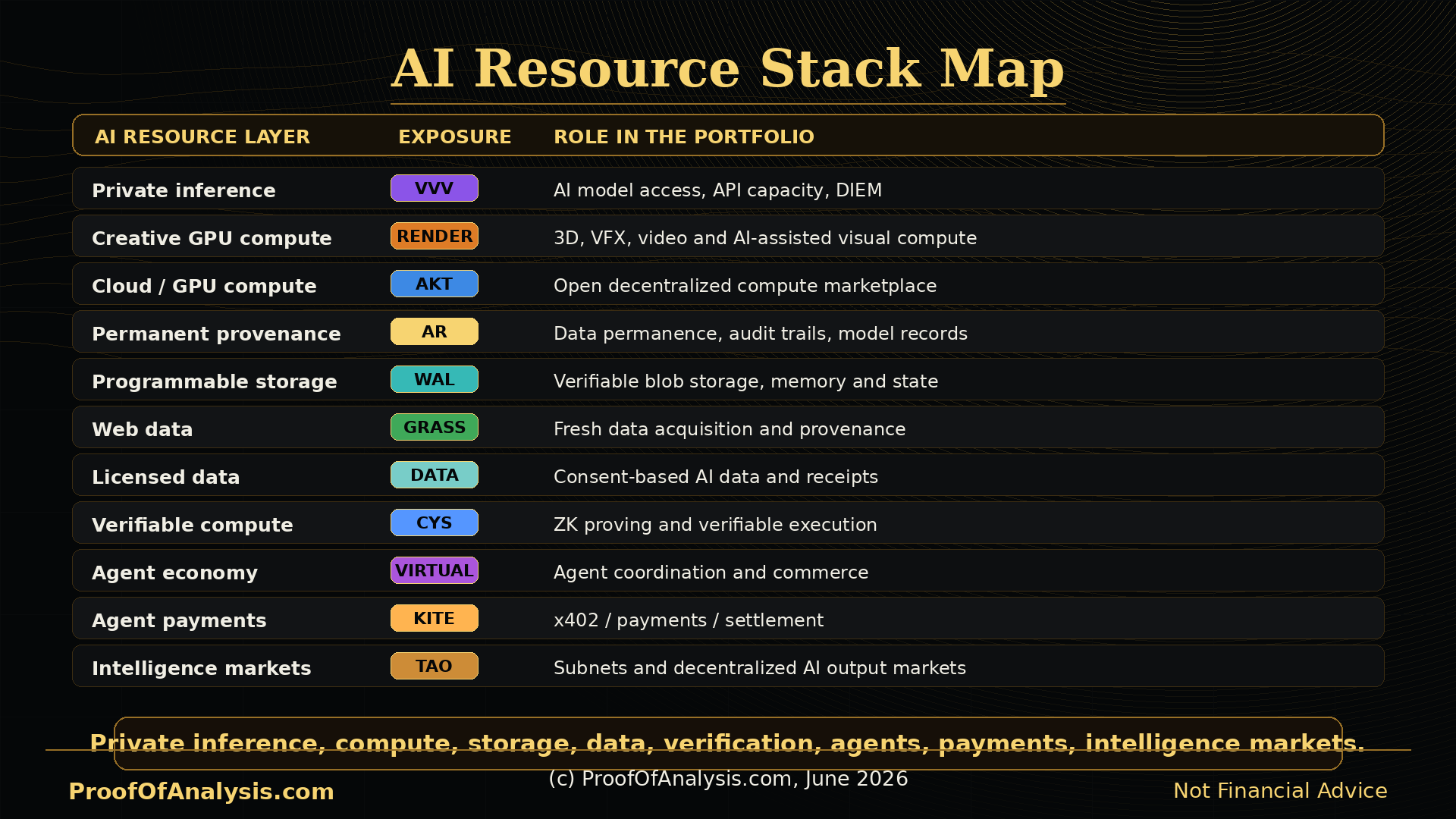
This is the core sentence:

We are not buying AI tokens. We are buying the resources AI systems must consume.

That is the difference between a portfolio and a theme basket.

This is not a “20 coins at 5% each” portfolio. That would look diversified while saying very little. This portfolio has a view.

We want 61% in core AI infrastructure, 34% in high-growth AI data and agent layers, and 5% in a strategic payments satellite.

The philosophy is simple:

We are not buying AI costumes. We are buying AI resource markets.

KITE - ?%

(Members can read the exact allocation below.)

KITE is our strategic agentic-payments satellite.

If autonomous agents become economically real, they need payments: API payments, service payments, usage limits, spend controls, identity, settlement and stablecoin routing. Kite is directly focused on this problem. Its whitepaper describes x402 as the interoperability layer between agents and services, allowing agents to convey payment intents while services verify authorization and terms.

This is a real category. Coinbase also describes x402 as a protocol for instant automatic stablecoin payments over HTTP, enabling services to monetize APIs and digital content onchain for both humans and machines.

The question is not whether agent payments matter. They do. The question is whether KITE captures enough value if many payments settle in stablecoins and if the x402 standard becomes broad rather than proprietary.

Why x%?
Because agentic payments are essential, but KITE’s token-capture path is more indirect than the core holdings.

Role: Agent payments and settlement infrastructure.
Main risk: Stablecoin rails may capture payment volume while KITE captures only coordination value.
What must improve: Agent Passport usage, payment volume, x402 integrations, fee capture, and staking/lock demand.


DATA Network

DATA is the portfolio’s consent-based AI-data turnaround.

The old Story/IP thesis was broad. The new DATA thesis is sharper: AI will need licensed, provenance-rich, consent-based data. That is a real market problem.

We include DATA because the pivot is strategically correct. AI labs need defensible data. The world is moving from “scrape everything and argue later” toward data provenance, rights, consent, licensing, auditing, and attribution.

The reason we only assign x% is that the token-capture remains unproven. A data marketplace can be useful while most economic value goes to data suppliers, buyers and offchain contracts. DATA must show that onchain licensing, receipts, traceability and data rails create recurring demand for the token itself.

Role: Licensed AI data and provenance.
Main risk: Useful protocol, weak token capture.
What must improve: Data receipts, paid buyers, licensing volume, CDR usage, and fee capture in DATA.


CYS / Cysic

Cysic gives the portfolio exposure to verifiable compute and ZK infrastructure.

This is not as immediately readable as VVV or VIRTUAL, but it may prove more important over time. If AI systems execute high-value tasks, markets will increasingly need proof: proof of computation, proof of inference, proof of data transformation, proof of correct execution.

Cysic’s documentation describes the project as building a ComputeFi platform that turns computing resources into verifiable, tokenized onchain assets, with CYS aligning incentives between users, compute providers and governance participants.

That is a strong technical thesis. But Cysic remains earlier in terms of transparent revenue and recurring paid workloads. We like the category. We do not yet treat it as a top-five core asset.

Why x%?
Because verifiable compute belongs in the portfolio, but the proof of demand is still developing.

Role: ZK and verifiable-compute infrastructure.
Main risk: Revenue opacity and unlock pressure.
What must improve: Paid proving jobs, AI-inference workloads, staking demand, Proof-of-Compute metrics, and customer transparency.


GRASS

Grass is our web-data acquisition bet.

AI models need fresh data. Agents need current web context. Retrieval systems need access to a world that changes every minute. Grass attacks that bottleneck by using a distributed network for web data collection and provenance.

The Grass documentation states that validators receive, verify, and batch router web transactions, then generate ZK proofs that can be referenced by datasets to verify provenance and track lineage.

That is the right problem. Data provenance will matter more, not less.

But Grass carries serious risks. Web scraping, residential proxy networks, data rights, site blocking, buyer concentration, and regulatory pressure are all real. The token-capture path is also not as clean as VVV, RENDER, AKT or WAL. We need to see more direct evidence that data revenue becomes GRASS demand.

Why x%?
Because Grass owns an important AI data thesis, but its legal and token-capture risks are too high for core weight.

Role: AI web-data acquisition.
Main risk: Scraping and data-rights friction.
What must improve: Verified data buyers, data revenue, router staking, decentralized validators, and transparent fee distribution.


TAO / Bittensor

TAO is the broadest decentralized intelligence-market exposure.

It is not a simple AI application token, and it should not be treated as one. Bittensor is a network of subnets that incentivize participants to produce digital commodities and AI-related outputs. The official documentation describes Bittensor as constantly emitting TAO to participants in proportion to the value of their contributions.

That is ambitious. It is also difficult to analyze.

TAO is a bet on decentralized AI market design: can open incentive markets allocate capital and emissions toward useful machine intelligence, compute, models, data, scoring, and services? If yes, TAO remains one of the most important AI crypto assets. If not, it becomes a sophisticated emissions machine with a heroic narrative.

There are real concerns. A 2025 empirical analysis of Bittensor documented concentration in stake and rewards and argued that rewards were heavily driven by stake, raising concerns about quality alignment.

We still include TAO because the upside is too large to ignore. But we size it below VVV, RENDER, AR, AKT, WAL, and VIRTUAL.

Why x%?
Because TAO offers broad AI-infrastructure optionality, but its complexity and incentive risks deserve a discount.

Role: Decentralized intelligence-market exposure.
Main risk: Emissions and stake concentration may not map cleanly to useful AI output.
What must improve: Subnet quality, revenue relevance, emission alignment, and evidence that buyers value subnet outputs.


VIRTUAL

Virtuals is the strongest direct AI-agent ecosystem asset.

It is not our largest holding because the agent sector is still noisy. It is in the portfolio because ignoring the clear category leader would be intellectually lazy.

The Virtuals whitepaper describes VIRTUAL as the currency used by agents to function, transact, and coordinate through the Agent Commerce Protocol. It also frames VIRTUAL as the base asset for the onchain agent economy.

That gives VIRTUAL real structural importance inside its ecosystem. Agents launch, trade, coordinate, and potentially transact through Virtuals. If tokenized AI agents become a major crypto category, VIRTUAL is one of the obvious beneficiaries.

But we need discipline. The agent market is still filled with weak autonomy, thin revenue, and speculative valuations. A recent empirical study of DeFi investment agents found that many current deployments remain early and heterogeneous, often lacking clear evidence of autonomous execution; it also found weak links between token valuations and treasury fundamentals, with tokens in its sample down 93% on average from all-time highs.

That is the red warning sign hanging over the entire agent category.

Why x%?
Because VIRTUAL is the best agent-economy beta, but not the cleanest infrastructure asset. We want exposure to the upside without letting agent reflexivity dominate the portfolio.

Role: AI-agent ecosystem leader.
Main risk: Agent-token speculation may outrun real agent revenue.
What must improve: ACP jobs, agent revenue, veVIRTUAL lock demand, agent-token buybacks from real earnings, and non-speculative usage.


WAL / Walrus

Walrus is our strongest newer storage allocation.

It is not simply “storage on Sui.” Walrus is a programmable, verifiable blob-storage network. The WAL token is used for paying storage fees, securing the network through staking, and participating in governance.

The technical design is also stronger than most young storage projects. The Walrus paper presents RedStuff, a two-dimensional erasure-coding protocol designed to achieve high security with only a 4.5x replication factor, while enabling efficient self-healing recovery and asynchronous storage challenges.

That matters because decentralized storage is not a new idea. The hard problem is making it efficient, verifiable, durable, and economically usable.

Walrus also has a natural AI angle: memory, datasets, audit trails, agent state, and programmable access control. We are not buying it because it says AI. We are buying it because AI systems will generate and consume vast amounts of stateful data, and some of that data needs verifiable persistence.

Why x%?
Because WAL has genuine infrastructure upside and appears materially undervalued relative to its technical seriousness, but it is still younger and less battle-tested than AR.

Role: Programmable verifiable storage.
Main risk: Revenue and paid usage are not yet transparent enough.
What must improve: Storage fees, active data growth, WAL staking, Walrus Memory usage, and non-Sui adoption.


AKT / Akash

Akash is our second major compute allocation.

The reason is not simply that Akash is a decentralized cloud marketplace. That thesis is old. The reason is that Akash has improved its token-capture logic.

Messari reported that Akash activated Burn-Mint Equilibrium through Mainnet 17 on March 23, 2026, tying every onchain compute workload to an AKT market buy and creating the first deflationary mechanism in the network’s history.

That is not a cosmetic upgrade. It changes what investors should monitor. AKT is no longer merely a governance/staking exposure to a decentralized cloud marketplace; usage now has a clearer path to token demand and potential supply pressure.

Akash still has a difficult market. Cloud is a scale business, and centralized providers are not exactly known for donating margins to idealists. But decentralized compute can win at the edges: permissionless access, GPU availability, censorship resistance, open marketplaces, and specialized workloads.

Why x%?
Because AKT has serious infrastructure relevance and better token economics after BME, but it still must prove that decentralized cloud demand can scale.

Role: Decentralized cloud and GPU compute.
Main risk: Centralized cloud competition and still-limited revenue scale.
What must improve: Compute leases, GPU utilization, BME burns, marketplace liquidity, and enterprise/developer demand.


AR / Arweave

Arweave is not marketed as the loudest AI coin. That is part of the appeal.

AI systems need provenance. They need durable datasets, model checkpoints, audit trails, generated-media records, synthetic-data logs, governance histories, and sources that remain verifiable over time. Permanent storage is not as theatrical as a tokenized agent avatar. It is more useful.

Arweave’s economic design is also unusually strong. Arweave describes an endowment model where storage fees go into a long-term pool to sustain permanent storage, and the AR token has a maximum supply of 66 million tokens, with 55 million created at genesis and 11 million gradually released as mining rewards.

That supply profile matters. Many AI tokens are not scarce assets; they are future unlock schedules in search of a narrative. AR is different. It has a clean scarcity profile and a clear product: permanent data.

The AI case for AR is not “AI agents will use Arweave because AI.” The case is narrower and stronger: if AI makes data provenance, source persistence, and auditability more valuable, Arweave sits in a strategically important layer.

Why x%?
Because AR is a durable infrastructure asset with strong supply characteristics. It deserves core weight. But permanent storage still has to prove that its addressable market grows beyond a respected niche.

Role: Permanent storage and provenance.
Main risk: The market may prefer cheaper, flexible, non-permanent storage for most data.
What must improve: Weave growth, storage fees, AI dataset usage, AO-related data writes, and endowment growth.


RENDER

Render is our highest-conviction mature compute asset.

The AI market obsesses over generic GPU supply, but Render has a more specific and defensible history: creative GPU rendering. That matters because AI-generated media, synthetic content, 3D workflows, video assets, virtual production, and design pipelines all require compute. Render does not need to replace hyperscale AI training to matter. It needs to remain a core compute layer for creative and AI-assisted visual workflows.

The token model is also cleaner than many AI infrastructure tokens. Render’s Burn-Mint Equilibrium model is designed to price services through a supply-demand mechanism, while network jobs are tied to token burns and emissions. Render’s knowledge base frames BME as the mechanism that allows creators to forecast rendering and AI job costs while node operators supply GPU services.

This is exactly the kind of token structure we prefer: usage should not merely create activity; it should create token demand, burn pressure, or staking demand.

RENDER is not a hidden smallcap. That is not the point. It is one of the few AI-adjacent crypto assets with actual product history, category relevance, and a more mature token model.

Why x%?
Because Render is a core compute asset, but its upside is more measured than younger infrastructure names. We want it large enough to matter, not so large that the portfolio becomes a legacy DePIN basket.

Role: Mature GPU / creative compute core.
Main risk: Growth must justify valuation; centralized GPU providers remain brutal competitors.
What must improve: AI job volume, burn data, creator demand, and compute subnet expansion.


VVV / Venice

Venice is not an abstract decentralized AI manifesto. It is a usable private AI product with an API. Users and developers can access AI models through Venice, and VVV is tied to that product through staking, platform access, and DIEM.

The DIEM mechanism is the key. Venice describes DIEM as tokenized AI inference: each DIEM provides $1 per day in API credit, and VVV holders can mint DIEM. Venice’s token page also states that VVV can be staked to earn yield, access Venice Pro, and mint DIEM.

That gives VVV a direct link to a resource AI systems actually consume: inference.

Many AI tokens ask us to believe that demand will arrive later. Venice has demand attached to product usage now. The token is not perfect, because it remains highly dependent on Venice as a company-like platform. But that concentration is also what makes the token model legible.

The bull case is not vague. If private AI usage grows, if developers use Venice’s API, if agents need private inference, if DIEM becomes a tradeable unit of AI access, VVV can sit directly inside the usage path. That is rare.

Why x%?
Because Venice is still a concentrated platform bet. VVV is not a neutral base-layer protocol. If Venice loses model quality, privacy credibility, API competitiveness, or cultural relevance, the token suffers. We want VVV as our largest AI application asset, not as half the portfolio.

Role: Core AI application-token exposure.
Main risk: Platform concentration.
What must improve: API usage, DIEM liquidity, recurring burns, paid user growth, and transparent revenue linkage.


Rebalancing rules

For a 24-month AI portfolio, daily price obsession is counterproductive. We would review quarterly, unless a major protocol event breaks the thesis.

This is especially important in AI crypto. Many projects will appear healthy until the incentives stop.


Red-team section: how this portfolio can fail

No serious portfolio should be published without attacking itself.

Here is the bear case.

1. Centralized AI may compress margins

OpenAI, Anthropic, Google, Meta, xAI, Apple and specialized infrastructure companies may continue to dominate model access and inference distribution. If centralized AI becomes cheap, private, and flexible enough, some crypto AI value propositions weaken.

2. AI tokens may not capture AI value

This is the central risk. A network can be useful while its token is not. We exclude many coins for exactly this reason, but even the selected names are not immune.

3. Agents may remain interfaces, not economic actors

The most overhyped part of the AI crypto market is autonomous agents. Many current deployments remain early, thin, or speculative. The empirical DeFi-agent evidence is not flattering.

4. Data markets may remain offchain

The best AI data deals may happen through private contracts, not onchain protocols. This would hurt DATA, GRASS and parts of the WAL/AR thesis.

5. Compute markets may commoditize

Decentralized compute networks must compete with centralized GPU clouds, specialized inference providers and massive cloud platforms. That is not a gentle market.

6. Emissions may beat usage

Several AI tokens still rely on incentives, staking rewards, or future unlock schedules. If usage grows slower than emissions, the chart will eventually notice.

It usually does.


Final view

This is the final POA base allocation: