Pump.fun ($PUMP): The Cash Machine Behind Crypto’s Most Disposable Market
Pump.fun has generated more than $1 billion in protocol revenue and hundreds of millions in PUMP buybacks. We examine whether that cash flow can outweigh insider unlocks, regulatory exposure and weak token-holder rights.

More than $1 billion in protocol revenue, hundreds of millions in token buybacks and one unresolved question: how much of Pump.fun’s success does PUMP actually capture?
Proof of Analysis Deep Dive
Pump.fun is an outstanding operating business attached to a materially weaker financial asset. PUMP offers measurable value capture at an attractive headline valuation, but token holders remain exposed to discretionary buybacks, insider vesting and unusually concrete regulatory risk.
Key takeaways
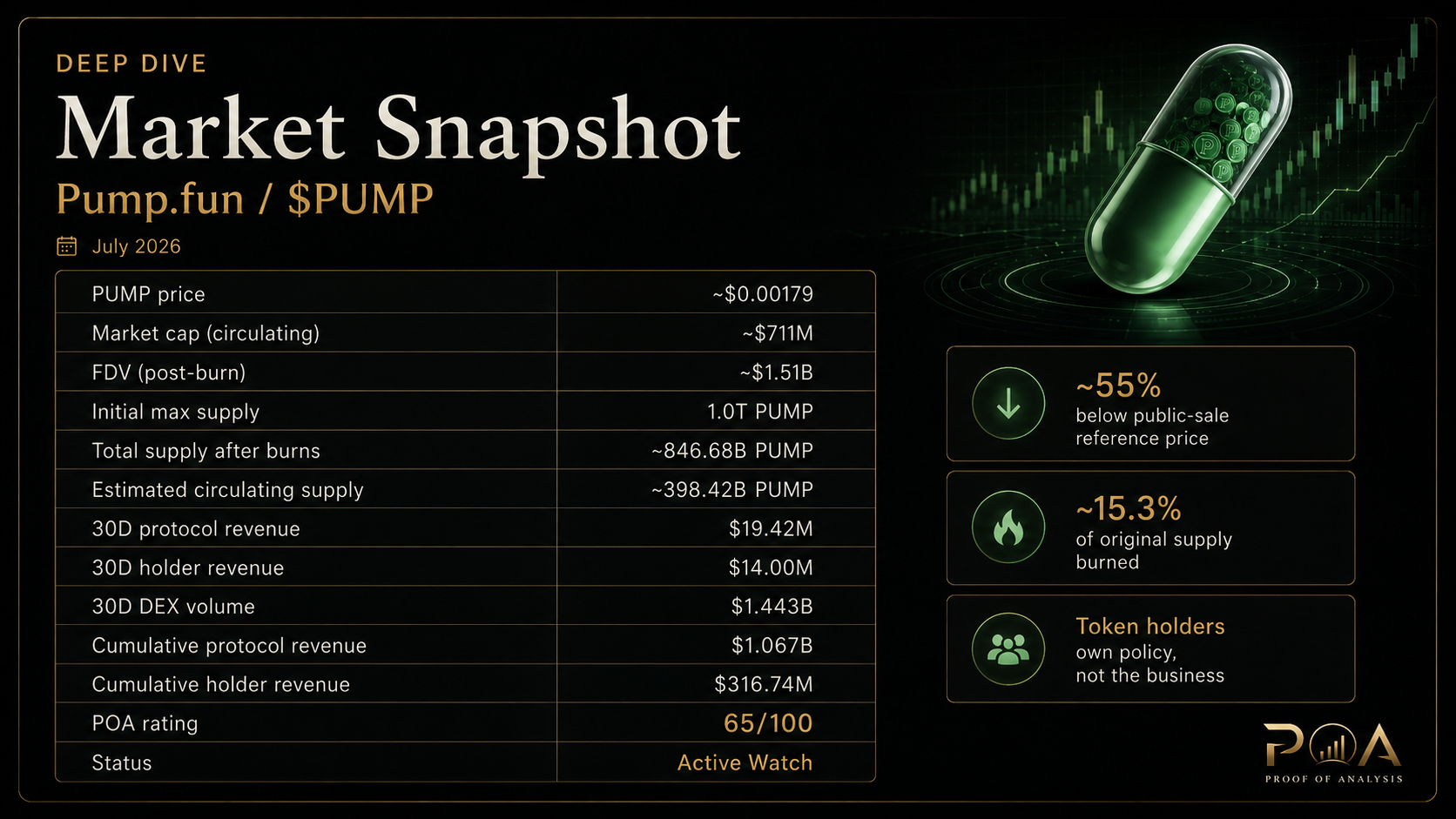
- Pump.fun has generated $1.067 billion in cumulative protocol revenue and processed $92.825 billion in cumulative DEX volume.
- PUMP buybacks and burns have produced $316.74 million in cumulative holder revenue and removed approximately 15.3% of the original supply.
- The current market capitalisation of roughly $711 million equals about 4.2 times annualised 30-day holder revenue.
- Team and previous investors originally received 33% of supply, and their three-year vesting cycle began in July 2026.
- PUMP holders possess no disclosed legal claim on Pump.fun’s corporate revenue, assets or future products.
- Our base-case valuation range is approximately $0.0017 to $0.0030. The current price sits in its lower half.

Executive verdict
Pump.fun is one of the rare crypto businesses whose financial performance requires no imaginative accounting. People use the product, trading activity produces fees, the protocol retains substantial revenue, and a large part of the resulting cash flow is used to buy and burn PUMP. The business has generated more than $1 billion in cumulative protocol revenue and remains capable of producing tens of millions of dollars per month. At the current valuation, that makes PUMP look remarkably inexpensive beside most liquid crypto assets.
That conclusion is accurate and incomplete.
PUMP does not give holders a legal claim on Pump.fun’s company, treasury or profits. Its economic value depends on a discretionary buyback-and-burn policy administered by a centralised operating company. The token also carries a heavy vesting burden: the team and previous investors received 33% of the original one-trillion-token allocation, and their three-year vesting period has now begun. Regulatory pressure is unusually concrete, while the underlying market consists largely of tokens with extremely short lives and poor outcomes for buyers.
Our rating is 65/100 — Active Watch, not High Conviction. Pump.fun is an outstanding operating business attached to a materially weaker financial asset. At approximately $0.00179, a market capitalisation near $711 million and an FDV around $1.51 billion after burns, PUMP offers a credible cash-flow trade. It does not yet qualify as a durable long-term compounder.
The investment case in one paragraph
The bullish thesis is that Pump.fun has become the default issuance and trading layer for Solana-native speculation. Its distribution, liquidity, brand and rapid product iteration give it a stronger moat than the simplicity of its code suggests. As of July 25, DeFiLlama reports $25.35 million in 30-day fees, $19.42 million in protocol revenue, $14.0 million in token-holder revenue and $1.443 billion in DEX volume. If the platform merely preserves current activity, continued buybacks can retire a meaningful percentage of supply. The bearish thesis is that present cash flow may be cyclical, competition can redirect creators quickly, insider unlocks can offset burns economically, and token holders possess no enforceable right to future revenue. PUMP is therefore a wager on management continuing to transfer corporate economics to a token while regulators tolerate the business and memecoin demand remains structurally relevant.
What Pump.fun actually built
Pump.fun launched in early 2024 with a brutally efficient proposition: anyone could create a Solana token in minutes, and that token could trade immediately through a standardised bonding curve. The design removed the technical work, initial liquidity decisions and most of the coordination previously required to launch a memecoin. Once a coin reached the relevant threshold, liquidity migrated into an automated market.
This changed token creation from a small project into a consumer action. Pump.fun did not need to predict which meme would succeed. It monetised the entire attempt set.
The product later expanded beyond the original launchpad. PumpSwap internalised post-graduation trading that had previously migrated mainly to Raydium. Livestreaming, a mobile application, social feeds, creator-fee sharing, cashback, Mayhem mode and trading-terminal functions widened the platform from issuance software into an integrated speculative marketplace. The current site exposes feeds, live content, competitions, callouts and a terminal beside token creation. This matters because the defensible product is no longer the bonding-curve contract alone. The emerging moat is the combination of audience, creator distribution, trading flow, data and culture.
The platform’s economic architecture is equally important. User trading fees are divided among protocol revenue, creator compensation and other incentives. Pump.fun’s current fee documentation applies different rates according to product and market-cap band. Under Project Ascend, creator fees on PumpSwap decline as a token grows, allowing small launches to pay creators more while reducing the burden on larger assets. Fee sharing can distribute creator revenue among multiple wallets and can support community takeovers. These features address a real weakness in early memecoin launchpads: creators previously had a strong incentive to sell token inventory because ongoing success generated little recurring income.
The model still has adverse incentives. Paying creators on volume can reward attention generation without improving asset quality. It may reduce direct dumping while encouraging a larger number of launches whose expected value for buyers remains poor. Pump.fun solved the creator monetisation problem more effectively than it solved the investor-outcome problem.
The central business insight
Pump.fun does not need to identify the next successful memecoin. It monetises the entire attempt set. Asset quality can remain extremely low while platform economics remain excellent.
Demand and financial performance
The operating numbers are exceptional by crypto standards.

Several distinctions prevent misreading these figures. “Fees” are total charges paid by users. “Protocol revenue” is the portion retained by Pump.fun after creator fees and cashback. “Holder revenue” measures PUMP purchases and burns; DeFiLlama notes that these buybacks aggregate multiple Pump products and do not reconcile exactly with the protocol-revenue series. Holder revenue should therefore be treated as observable token support, not as distributable profit.
The quarterly history reveals both resilience and cyclicality. Gross protocol revenue reached $263.82 million in Q1 2025, fell to $144.2 million in Q2, recovered to $110.5 million in Q3 and $100.97 million in Q4, then rose to $108.3 million in Q1 2026 before declining to $79.2 million in Q2. The current quarter has produced $20.44 million through July 25. Pump.fun remains extremely profitable, but peak-era revenue should not be used as a normalised baseline.
At the 30-day rate, protocol revenue annualises to approximately $236 million and holder revenue to $168 million. The trailing daily reading is stronger, although extrapolating a single day would be poor analysis. Our base valuation uses the 30-day and Q2 rates. They already place Pump.fun among the highest-revenue crypto applications.
Revenue quality requires a harsher assessment. Trading volume is external demand in the narrow financial sense: users voluntarily pay for the service. It is also highly dependent on speculative turnover, Solana activity and cultural attention. There are no subscriptions, contracted customers or long-duration commitments. A token launch takes seconds, and users can migrate to a rival launchpad almost as quickly. Pump.fun’s cash flow is real, recurring and volatile.
POA interpretation
The revenue is genuine. Its duration is unproven. Investors should value Pump.fun through normalised cycle revenue rather than extrapolating its strongest quarter or latest trading day.
Market structure and competitive moat

The launchpad market initially appeared to be a winner-takes-most category. Pump.fun combined brand recognition with the largest pool of traders, giving creators an obvious reason to launch where buyers already congregated. That feedback loop remains its strongest defence.
The events of 2025 exposed its limits. LetsBonk briefly displaced Pump.fun in daily revenue and launch activity by combining creator incentives with the BONK ecosystem. Pump.fun later recovered much of its share after changing fees and improving PumpSwap. Bags, Believe and other platforms showed that distribution can be imported from creator communities, social networks or existing tokens. The relevant moat is therefore adaptive execution rather than immutable technology.
Pump.fun has four material advantages:
- Liquidity and attention. Creators care about immediate buyers more than protocol elegance. Pump.fun still offers one of the deepest pools of speculative attention in crypto.
- Vertical integration. Issuance, bonding-curve trading, graduation, AMM liquidity, creator payments, social discovery and terminal functions increasingly remain inside one economic system.
- Data and iteration. A large launch and trade history allows rapid fee experimentation and better ranking, moderation and trading tools.
- Cultural ownership. “Launching on Pump” has become a recognised action. In consumer markets, habitual language can support distribution even when switching costs are low.
Its disadvantages are equally structural. Code can be copied, creators can multi-home, liquidity is mercenary, and memecoin communities often organise around a token rather than a platform. Competitors can subsidise activity with their own tokens. A single successful rival asset can redirect attention for weeks. Pump.fun must keep shipping because its moat weakens whenever the product stops evolving.
The acquisition of trading-terminal capabilities and the expansion into mobile and social products indicate that management understands this. The long-term opportunity is larger than launch fees: Pump.fun could become a crypto-native consumer exchange whose acquisition funnel begins with memes. The evidence currently supports the launchpad and DEX business. It does not yet support assigning material value to a broader social platform.
Tokenomics: the part that demands precision
PUMP launched in July 2025 with a maximum supply of one trillion tokens.

The sale structure was unusually large. DeFiLlama records $1 billion raised, consisting of a $400 million private token sale and a $600 million ICO. At the public-sale valuation of roughly $4 billion FDV, buyers paid about $0.004 per PUMP. The current price near $0.00179 is approximately 55% below that reference point and almost 80% below the September 2025 all-time high of $0.008819.
The buyback-and-burn programme has materially changed total supply. CoinGecko reports an on-chain total supply of approximately 846.68 billion, implying that roughly 153.32 billion PUMP, or 15.3% of the original maximum, has been removed. DeFiLlama reports $316.74 million in cumulative holder revenue. These are economically meaningful numbers, far beyond a cosmetic burn.
The circulating-supply picture is less clean. We estimate approximately 398.42 billion circulating PUMP, while other vesting trackers report higher unlocked quantities after the July 2026 insider release. These values measure different things: contractual unlocking, wallet transferability, circulating classification and burned supply are not interchangeable. The discrepancy is itself a risk factor. Investors should track named vesting wallets and exchange inflows rather than relying on a single displayed percentage.
Team and prior investors received 330 billion tokens combined. After a one-year cliff, their vesting began in July 2026 and runs over three years. On-chain reports identified approximately 57.28 billion PUMP distributed to 121 wallets in the first major release. Transfers do not prove sales, yet they convert latent dilution into liquid optionality. Monthly vesting now creates persistent overhead at the exact time when the burn mechanism appears most attractive.
Community and ecosystem tokens add another layer of discretion. Their label suggests growth expenditure, although holders have limited visibility into recipient selection, schedules and economic returns. A protocol can burn PUMP with one hand and distribute ecosystem inventory with the other. Net supply change and the identity of marginal sellers matter more than the buyback headline.
The metric that matters
Net Buyback Coverage = 30-day holder revenue ÷ market value of newly liquid insider and ecosystem supply
Gross buybacks can look impressive while net technical supply pressure remains negative. Burns, unlocks and exchange inflows must therefore be analysed together.
Value capture: real, powerful and revocable

Pump.fun’s strongest fundamental feature is direct open-market demand for PUMP. Buybacks convert platform activity into token purchases; burns reduce outstanding supply. Unlike governance tokens whose value depends on hypothetical future votes, PUMP has observable economic support today.
The mechanism has three important limitations.
First, PUMP is not equity. Holders have no disclosed legal entitlement to Pump.fun’s revenue, assets, future products or sale proceeds. If the operating company altered the buyback rate, redirected fees or launched a new product outside the token’s economic perimeter, holders would have limited recourse.
Second, the mechanism is centrally administered. The programme’s effectiveness depends on management behaviour, wallet controls and transparent accounting. On-chain burns are verifiable after execution; the policy governing future execution is not credibly neutral.
Third, gross buybacks are an incomplete measure during vesting. A company purchasing $14 million of tokens in a month can still experience negative net technical supply pressure if insiders and ecosystem recipients sell more than that amount. The correct framework compares buyback dollars with unlocked tokens, realised exchange inflows and trading liquidity.
This distinction leads to our central analytical insight: PUMP’s burn behaves less like a fixed protocol rule and more like a variable capital-allocation decision. Investors should value it with a governance discount. A dollar of mandatory, immutable token accrual is worth more than a dollar of discretionary repurchase, even when both are visible on-chain.
Why the headline multiple misleads
Holder revenue is observable token demand. It is not an audited profit distribution, dividend or enforceable ownership right. PUMP therefore deserves a lower multiple than an asset with equivalent cash flow and legally protected claims.
Governance, team and operational risk
Pump.fun was founded by Alon Cohen, Dylan Kerler and Noah Tweedale. The team has demonstrated exceptional product execution, monetisation and competitive speed. Building a billion-dollar-revenue consumer crypto platform in roughly two years deserves a high operational assessment.
Institutional diligence must also account for limited corporate transparency. The relationship among Baton Corporation Ltd., operating entities, token treasury, intellectual property and token holders is not presented with the disclosure expected from a public company. There is no conventional audited income statement, board accountability or shareholder-style protection for PUMP buyers. Token governance is minimal; meaningful control remains with the company.
The May 2024 incident adds a security precedent. A former employee allegedly exploited privileged access, resulting in about $2 million of losses. DeFiLlama classifies the event as an infrastructure compromise. The platform recovered and subsequently scaled far beyond that period, but the episode demonstrates that operational permissions can matter as much as audited contracts.
Founder reputation also deserves a discount. A 2025 WIRED investigation linked co-founder Dylan Kerler’s earlier online identities to questionable token launches during the 2017 ICO period. The allegations are not a judicial finding. They remain relevant when evaluating a business built around retail token issuance and concentrated managerial discretion.

Legal and regulatory exposure
Pump.fun faces one of the clearest regulatory risk profiles among large crypto applications.
The UK Financial Conduct Authority placed Pump.fun on its warning list in December 2024, stating that it may be providing or promoting financial services without permission. The platform subsequently blocked UK users. This is an enacted market-access restriction, not a theoretical policy concern.
In the United States, proposed class actions have alleged that Pump.fun and related parties offered or facilitated unregistered securities and profited from manipulative token activity. Later pleadings reportedly expanded the legal theories to include racketeering-related claims. Allegations are not proven facts, and memecoins do not automatically satisfy securities tests. The litigation still creates discovery, cost, reputational and business-model risk.
The platform also faces moderation and intellectual-property problems. Permissionless creation allows users to issue tokens bearing celebrity names, brands, tragic events or threatening material. Livestreaming has previously generated severe content incidents. Every moderation improvement introduces operating cost and potential liability; weak moderation creates a different liability. The product’s openness is commercially useful and legally expensive.
A regulatory action need not prohibit Pump.fun globally to damage PUMP. Geoblocking major markets, restricting app-store distribution, limiting fiat access, pressuring centralised exchanges or imposing KYC obligations could reduce volumes. Since current valuation depends on continuing buybacks, even partial friction has a direct financial transmission channel.
Risk transmission
Regulatory friction affects PUMP twice: it can reduce platform revenue and simultaneously lower the market multiple investors are willing to pay for each dollar of token buyback.
Valuation
At approximately $0.00179, PUMP’s estimated circulating market capitalisation is about $711 million. Applying the price to the post-burn supply of 846.68 billion produces an effective FDV near $1.52 billion; applying it to the original one-trillion maximum produces $1.79 billion. We prefer the post-burn figure for outstanding economics and retain the original-supply figure as a conservative reference because allocation and vesting disclosures still use one trillion.
Three cash-flow lenses are useful:

These multiples look cheap. They are not equivalent to price-to-earnings ratios. Holder revenue is token-purchase volume, not cash distributed to investors; the policy is discretionary; unlocks dilute circulating ownership; and the token carries no enforceable corporate claim. A substantial discount is therefore justified.
We use a scenario framework rather than a single target:
Bear case
Annual holder revenue falls to $60–90 million as memecoin activity weakens, competitors take share and regulatory friction rises. The market assigns a 3–5x multiple because buybacks remain discretionary and insider supply continues. Implied token value falls into a broad $180–450 million range. Depending on circulating classification, that supports prices roughly between $0.00045 and $0.0011.
What would produce this outcome: sustained market-share losses, monthly protocol revenue below $10 million, heavy insider exchange inflows or additional geographic restrictions.
Base case
Annual holder revenue normalises around $150–200 million, Pump.fun retains category leadership, and buybacks broadly offset new liquid supply. A 5–7x multiple yields $750 million to $1.4 billion of token value. That corresponds approximately to $0.0017–$0.0030, with the range widening as circulating supply changes.
What would produce this outcome: stable category leadership, monthly holder revenue near recent averages and no major deterioration in legal or exchange access.
Bull case
Pump.fun becomes the dominant consumer trading application on Solana, annual holder revenue reaches $300–400 million, and management makes the buyback policy durable and transparent. An 8–10x multiple yields $2.4–4.0 billion, supporting approximately $0.0045–$0.0070 after allowing for additional vesting and burns.
What would produce this outcome: successful expansion beyond launches, durable mobile and terminal adoption, transparent capital allocation and buybacks that consistently exceed newly liquid supply.
The current price sits near the lower half of our base range. That creates upside, though the asymmetry is less dramatic than the headline buyback yield suggests. The public-sale price around $0.004 remains a useful behavioural overhang: a return to that level would allow early public buyers to exit near cost while insiders continue vesting.
Valuation conclusion
PUMP is inexpensive under stable-revenue assumptions. It becomes genuinely undervalued only if current value capture persists through the insider-vesting cycle and management preserves the token’s economic perimeter.
POA-100 score
Free subscribers know more!