Bittensor ($TAO): The Market for Machine Intelligence
Bittensor is building a decentralized market for machine intelligence. We examine subnet economics, Dynamic TAO, Alpha tokens, emissions, external revenue, concentration risks and the conditions required for TAO to become a durable AI infrastructure asset.


The Most Sophisticated Subsidy Machine in Crypto?
Bittensor is probably the most intellectually ambitious project in crypto AI. It is also one of the easiest to misunderstand.
The usual description — “Bitcoin for AI” — is memorable, commercially effective and only partly correct. Bittensor borrows Bitcoin’s fixed supply, halving schedule and permissionless production model. But the commodity being rewarded is not objectively measurable hash power. It can be inference, compute, storage, prediction, model evaluation, training data, agent trajectories or almost any other digital product a subnet decides to incentivize.
That difference changes everything.
Bitcoin asks one comparatively simple question: who contributed valid computational work?
Bittensor asks a much harder one:
Who created valuable machine intelligence, who measured that value correctly, and how much of the network’s monetary issuance should flow toward it?
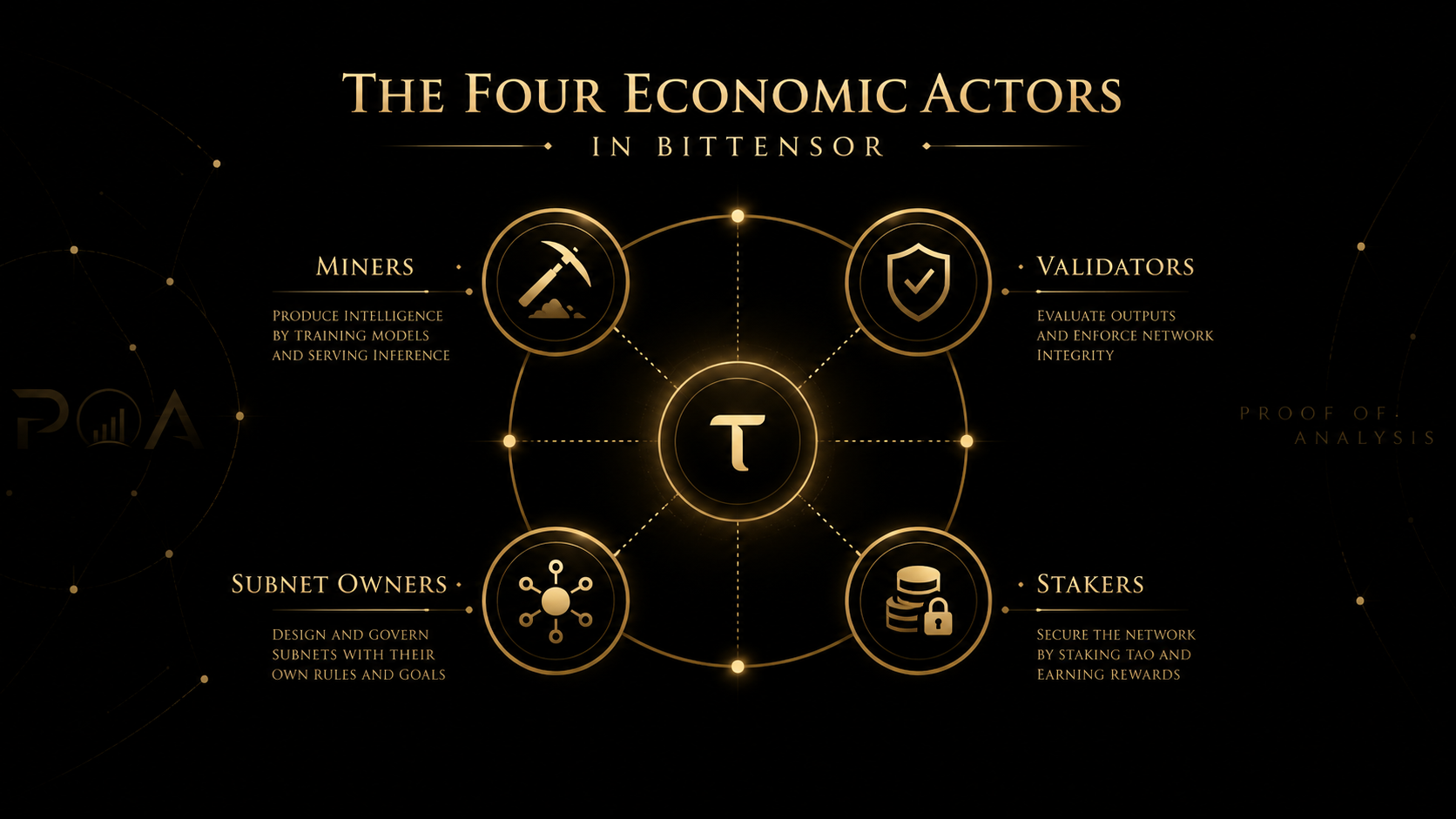
Bittensor’s answer is a programmable network of competing digital commodity markets called subnets. Miners produce work. Validators evaluate it. Subnet owners design the incentive mechanism. Stakers allocate capital. TAO and subnet-specific Alpha tokens coordinate the economy.
This is not merely decentralized AI compute. It is an attempt to build a decentralized capital market for machine intelligence.
1. Market snapshot
TAO currently trades at approximately $205. Current supply data differs across aggregators: CoinMarketCap reports roughly 11.14 million circulating TAO, while CoinGecko still displays a materially lower figure of approximately 9.6 million. We use the approximately 11.1 million figure because it is closer to current chain-based issuance data. At that supply and price, TAO’s implied circulating market capitalization is approximately $2.28 billion, with a fully diluted valuation near $4.30 billion. Roughly 53% of the maximum supply has been issued.
TAO reached an all-time high near $758 in March 2024 and currently trades roughly 73% below that level. This is no longer an early microcap. Nor is it priced as an inevitable winner. The market is assigning substantial value to Bittensor’s architecture while applying a significant discount to its execution and monetization uncertainty.
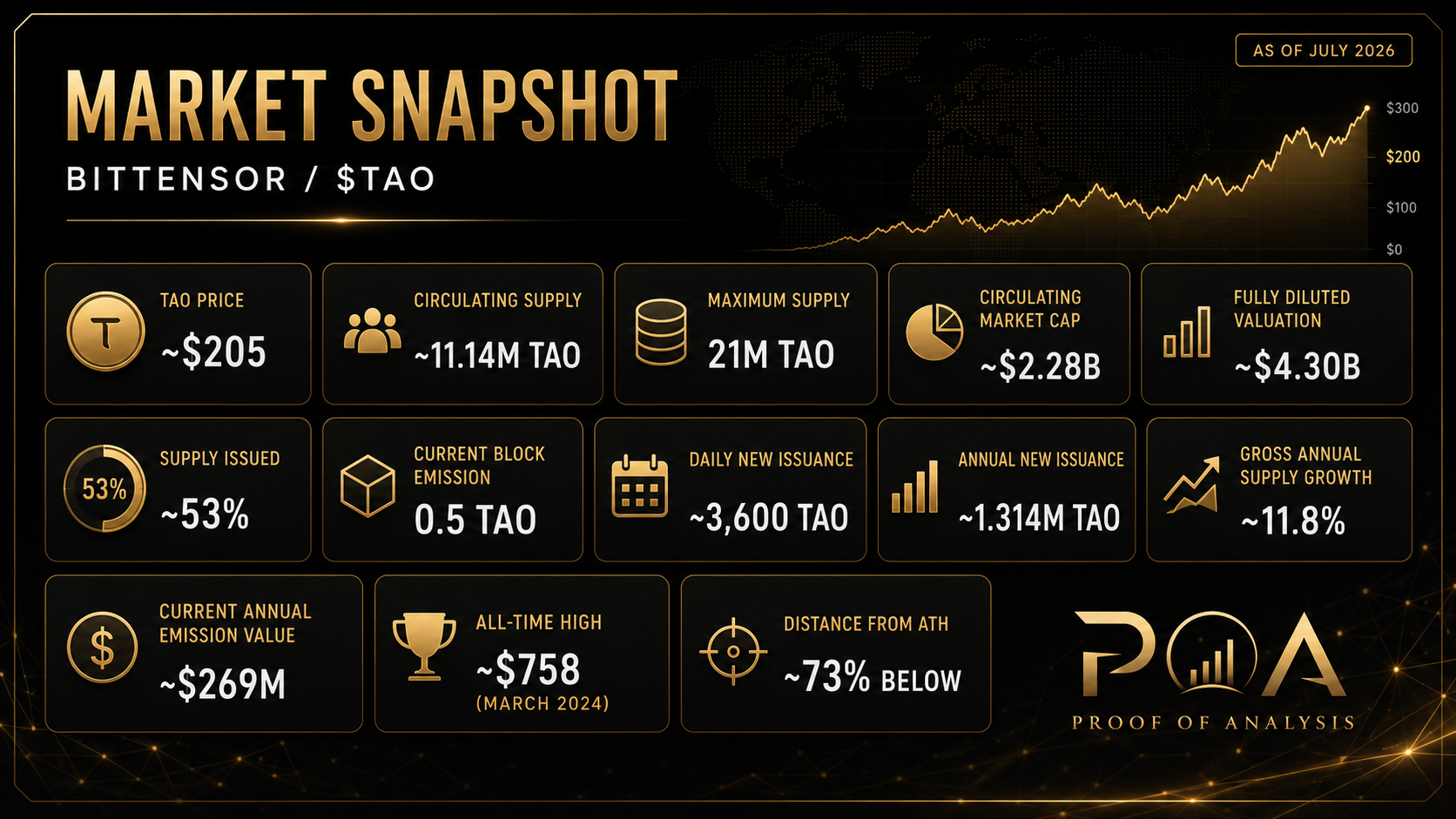
The last two figures are central to the investment case.
At the current token price, Bittensor distributes approximately $738,000 of new TAO per day, or about $269 million per year, to subnet participants. This is not a conventional operating expense. It is a dilution-funded network subsidy. But economically, it is the amount of value the network asks tokenholders and new buyers to absorb each year at the current price.
A serious TAO analysis must therefore answer:
Is Bittensor producing at least $269 million of annual economic value — or building an ecosystem likely to justify that subsidy through future external demand and monetary premium?
At present, the honest answer is: not demonstrably, at least not through standardized, auditable external revenue.
2. What Bittensor actually is
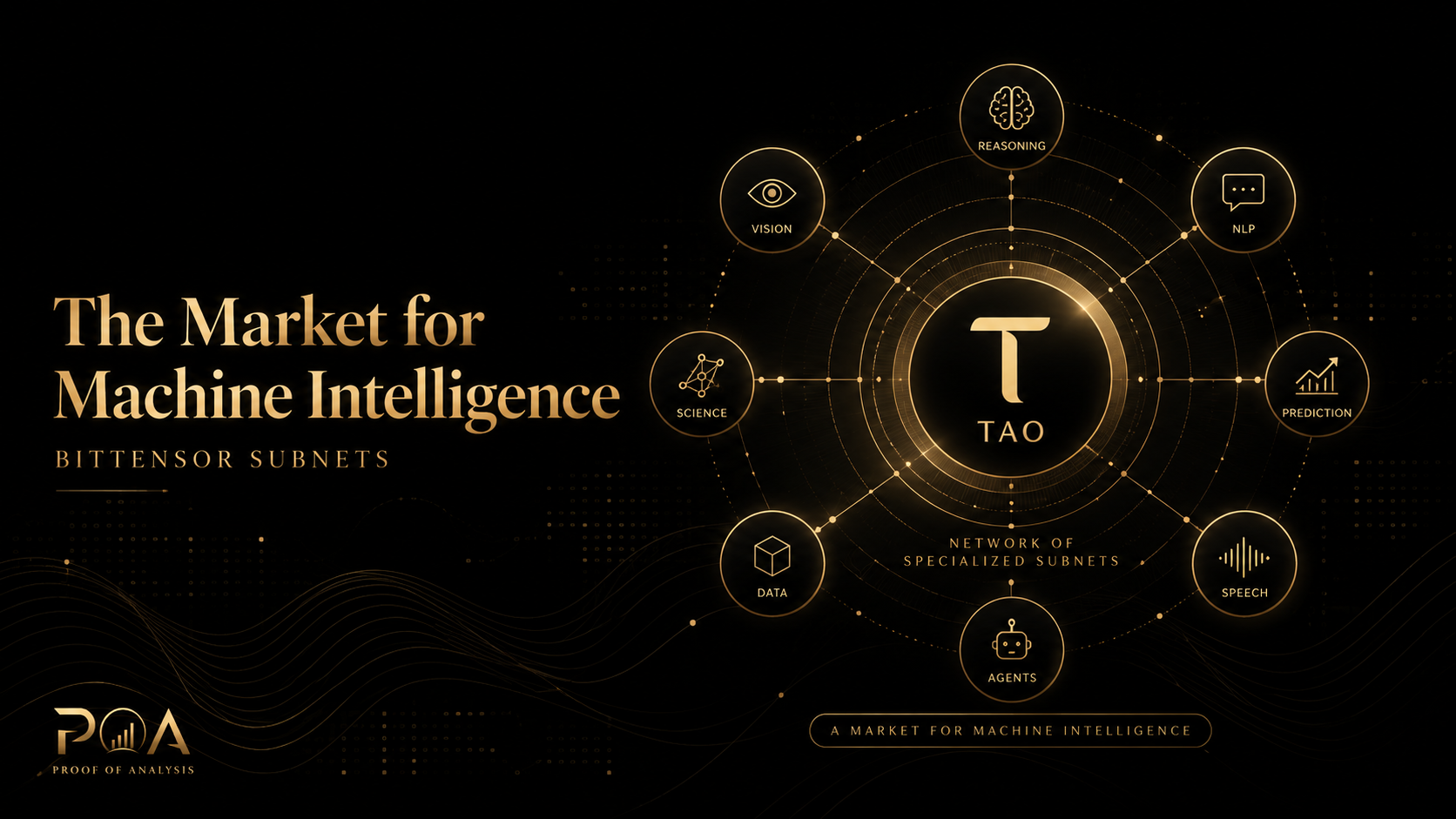
Bittensor is an open protocol for creating specialized markets that produce digital commodities. The official documentation lists examples including inference, training, compute, storage, financial prediction and other forms of machine intelligence. Each market operates as an independent subnet with its own miners, validators, incentive mechanism and Alpha token.
The network currently supports 128 specialized subnet slots, plus Subnet Zero — the Root network. Grayscale described 129 subnets in March 2026, effectively counting the Root network alongside the 128 specialized markets. The fixed subnet limit creates competitive pressure: new subnets can enter, while unsuccessful ones can eventually be deregistered.
A useful analogy is not “one decentralized AI model.”
It is:
A permissionless holding company containing 128 experimental AI and digital-resource businesses, financed through a common monetary system.
The protocol supplies several shared functions:
- TAO as the reserve and entry asset.
- Alpha tokens as subnet-specific economic exposure.
- A blockchain for accounting and reward distribution.
- Yuma Consensus for translating validator assessments into rewards.
- Open registration for miners, validators and subnet creators.
- A common capital market connecting otherwise different AI products.
The subnets provide the actual commodities.
This division is Bittensor’s strongest design choice. The base chain does not need to define what “good AI” means for every possible task. Each subnet defines its own scoring system, and Bittensor supplies the market and settlement framework.
3. The four economic actors
Miners
Miners produce the commodity. Depending on the subnet, this might mean serving inference, supplying GPUs, retrieving data, generating predictions, storing files or producing agent trajectories.
Validators test and rank miner output. After the subnet owner’s allocation is deducted, approximately 41% of subnet emissions go to miners.
Validators
Validators design or execute evaluation processes. They send tasks to miners, judge their output and publish weights that influence reward distribution.
Validators are not equivalent to ordinary proof-of-stake block validators. Their central economic role is judging the quality of a subnet’s commodity. Approximately 41% of subnet emissions go to validators and their stakers.
Subnet owners
Subnet owners define the product, maintain the incentive mechanism and coordinate development. The standard owner cut is 18% of Alpha emissions, although subnet owners may reduce their take. Owner rewards are delivered as staked Alpha, aligning the owner economically with the subnet’s token.
Stakers
TAO holders allocate capital to validators and subnets. Under Dynamic TAO, staking TAO into a specialized subnet exchanges the TAO for that subnet’s Alpha token through an onchain automated market maker.
Stakers therefore do not merely earn a generic network yield. They take:
- Subnet selection risk.
- Alpha price risk.
- Validator risk.
- Liquidity and slippage risk.
- Incentive-mechanism risk.
- Deregistration risk.
This is closer to allocating venture capital than delegating to a conventional proof-of-stake validator.
4. Yuma Consensus: Bittensor’s real invention
Bittensor’s deepest innovation is not the TAO token. It is the separation between blockchain accounting and offchain evaluation...