Cysic / $CYS - FREE Fundamental Analysis
Cysic is one of the stronger projects from the current AI/ZK/ComputeFi cohort. Cysic is building infrastructure for verifiable compute, primarily for ZK proofs, and later for AI inference, scientific workloads, and tokenized compute markets.


- Quick Verdict
Fundamentally, Cysic is one of the stronger projects from the current AI/ZK/ComputeFi cohort. The core is more plausible than many AI coins: Cysic is building infrastructure for verifiable compute, primarily for ZK proofs, and later for AI inference, scientific workloads, and tokenized compute markets. The project features a mainnet, its own L1, a Proof-of-Compute mechanism, ZK hardware expertise, an ASIC/FPGA/GPU thesis, real ZK partners, solid backers, and a token model that binds CYS more tightly to usage than many pure governance tokens.
The main caveat: The token is already trading quite ambitiously on an FDV basis, while the truly hard demand still has to prove that it comes sustainably from paying proving/inference workloads. Testnet numbers, node campaigns, and airdrops look good, but can be heavily incentive-driven in early DePIN/compute projects. Cysic reports 10M+ ZK proofs, 1.4M wallets, and 260K+ nodes, which appears more substantial than standard quest metrics, but institutionally, it is not yet the same as transparent protocol revenue.
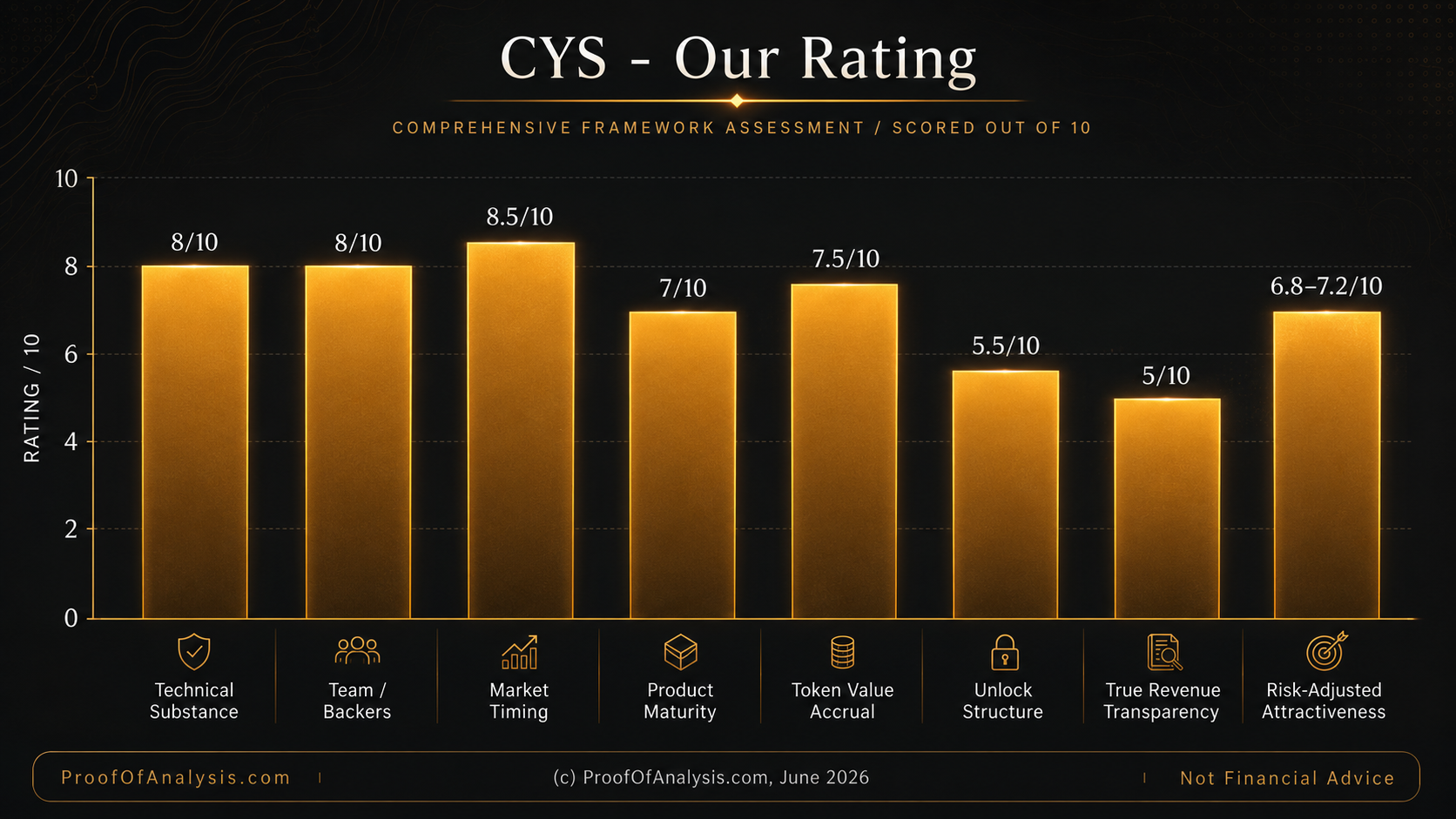
In short: CYS is not an empty AI ticker. Cysic is a serious infrastructure project. The token is interesting, but the valuation already assumes that Cysic will turn ZK proving and AI compute into a real network economy.
- What Cysic is Building
Cysic describes itself as a full-stack verifiable compute network. The idea is to bring computing power from GPUs, ASICs, FPGAs, servers, mobile devices, and specialized hardware clusters into an on-chain coordinated network. Users or protocols submit compute tasks, such as ZK proofs, AI inference, or other verifiable workloads; compute providers execute them; verifiers check the results;
Rewards and settlement run via the Cysic chain. The architecture consists of several layers:
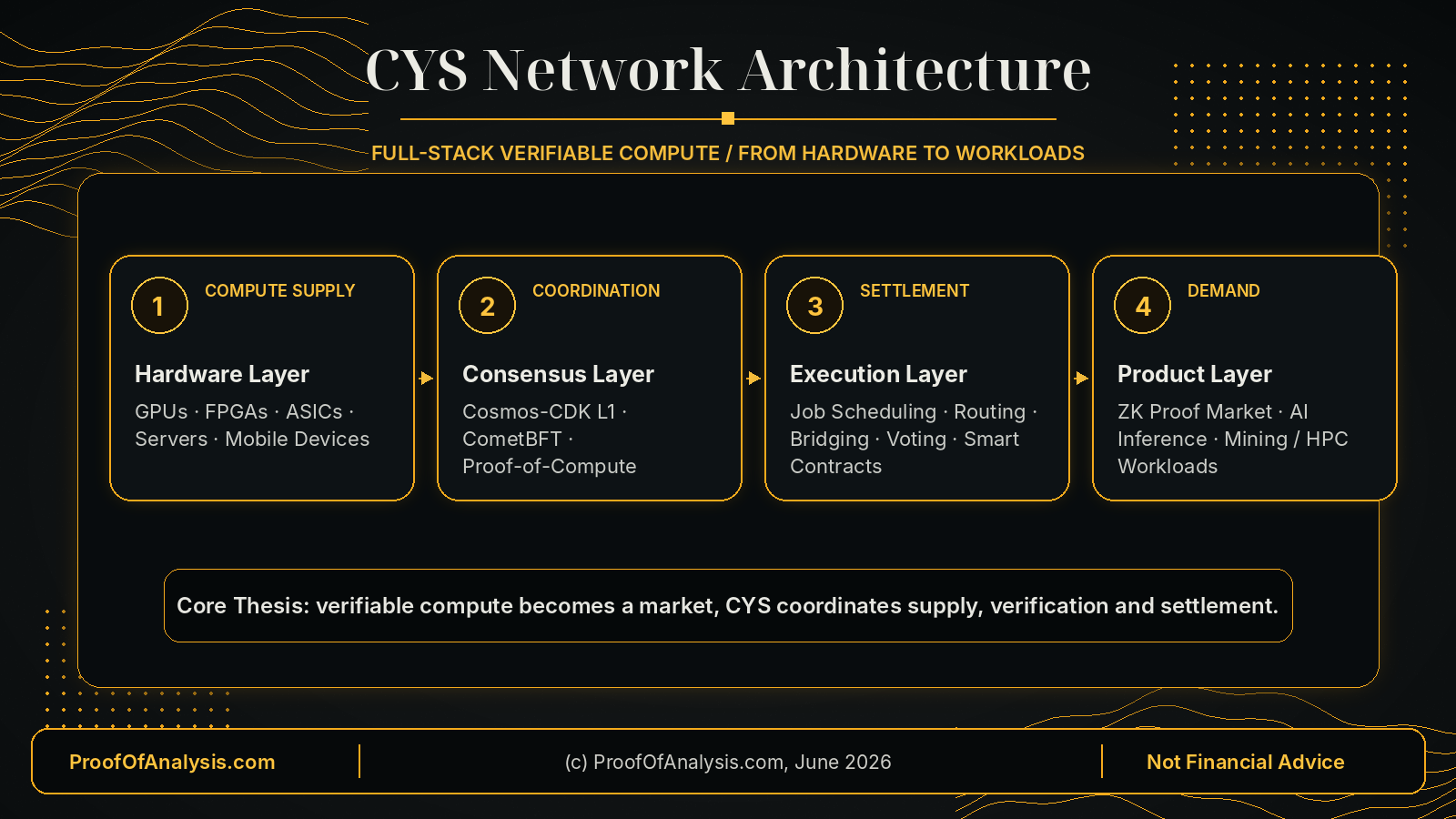
The docs explicitly state that Cysic is based on the Cosmos CDK as an L1, uses CometBFT, and that Proof-of-Compute includes not only staked tokens but also contributed computing power into the consensus.
This is a serious approach. Cysic doesn't just want to be a "GPU DePIN." The core thesis is: Verifiable compute will become its own market. ZK rollups, zkVMs, bridges, AI agents, scientific calculations, and DePIN workloads need external compute layers whose results are verifiable.
- Why the Market for This is Real
The ZK market has a real problem: Proof generation is expensive, slow, and hardware-intensive. This is exactly where Cysic comes in. The company was founded in 2022 to make ZK proving significantly faster and cheaper through hardware acceleration. The $12M Pre-A round reported in 2024 was led by HashKey Capital and OKX Ventures;
participants included ABCDE, Bit Digital, IDG, Matrix Partners, Polychain, SNZ, and Web3.com Ventures, among others. For its mainnet rollout, Cysic reported over 10 million processed ZK proofs, 1.4 million wallets, 260,000+ nodes, and integrations or services for ecosystems like Scroll, Aleo, Succinct, Nexus, Boundless, Polygon CDK projects, and ETHProof. This is the strongest part of the investment case: ZK is not a buzzword claim.
The Ethereum roadmap, rollups, zkVMs, proof aggregation, and verifiable AI create a long-term market for faster proofs. Cysic is positioned at a real bottleneck.
- Technology: Strong Core, Mixed Openness
Cysic has made real technical work visible. The public GitHub shows, among other things, Venus, a zkVM extension based on Polygon Hermez’s ZisK, aiming for GPU, FPGA, and ASIC optimization.
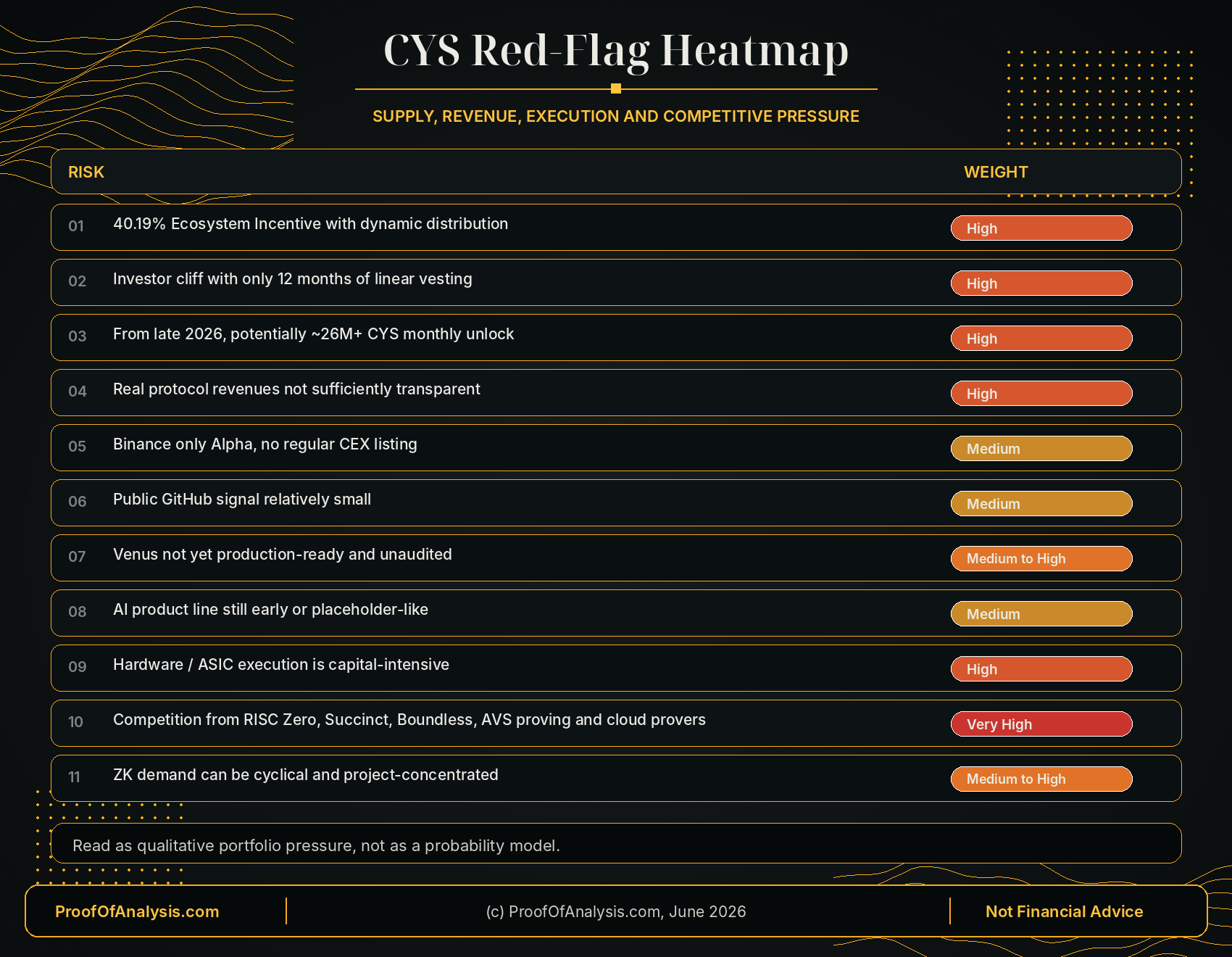
Cysic describes its own contributions such as CUDA optimizations, full FPGA acceleration under venus-acc, and initial ASIC-oriented zkVM acceleration. The sober point: According to the repository, Venus is under active development, not fully tested, and not recommended for production environments until a stable version is available.
This is not a flaw for a young ZK system, but it limits the institutional proof-of-concept of the open-source signal. The public GitHub traction is also modest: The Cysic Labs organization showed 139 followers at the time of retrieval; Venus had 15 stars and 2 forks. For a deep hardware/proving team, GitHub is not the only quality metric, because a lot of hardware and client work remains proprietary.
Nevertheless, the public developer signal is significantly smaller than for projects whose open-source ecosystem is growing organically.
Interpretation: The technical thesis is strong. Public developer adoption is not yet strong enough to serve as proof of adoption on its own.
- Product Landscape: ZK Stronger Than AI
Cysic is strongest where it originally comes from: ZK proof generation, hardware acceleration, prover/verifier network. The AI layer is relevant, but currently more of an extension than a proven core. The Cysic docs now describe a broad AI product line: Inference Service, Agent Marketplace, Skills Market, CyHost, CyClaw, and CyOps. Cysic AI aims to become the automation layer over ComputeFi; every agent run, every workflow system, and every inference consumes compute and could make demand visible in the long term.
The caveat is clear: Parts of this AI layer still feel like product validation.
Our verdict: Cysic should primarily be evaluated as a ZK/verifiable compute project. AI is an additional demand vector. Anyone buying CYS solely as an AI agent token misses the core.
- Team and Backers
The team case is solid. Leo Fan, founder and CEO, holds a PhD in Computer Science from Cornell under Elaine Shi according to a DefiLlama interview, worked on cryptography, formal methods, and verifiable systems, and was previously an Assistant Professor at Rutgers as well as active in research environments like Algorand, IBM T.J.
Watson, Bell Labs, and Yahoo Labs. The backers are equally strong: Polychain, HashKey, OKX Ventures, ABCDE, Matrix, SNZ, Bit Digital, and other names appear in the funding details.
Qualitatively, this is significantly better than many new AI/DePIN tokens. Cysic feels like a project born out of a real technical bottleneck, not from an afterthought narrative rebranding.
- Tokenomics
CYS has a fixed supply of 1 billion tokens. According to the Foundation docs, the token went live in Q4 2025.
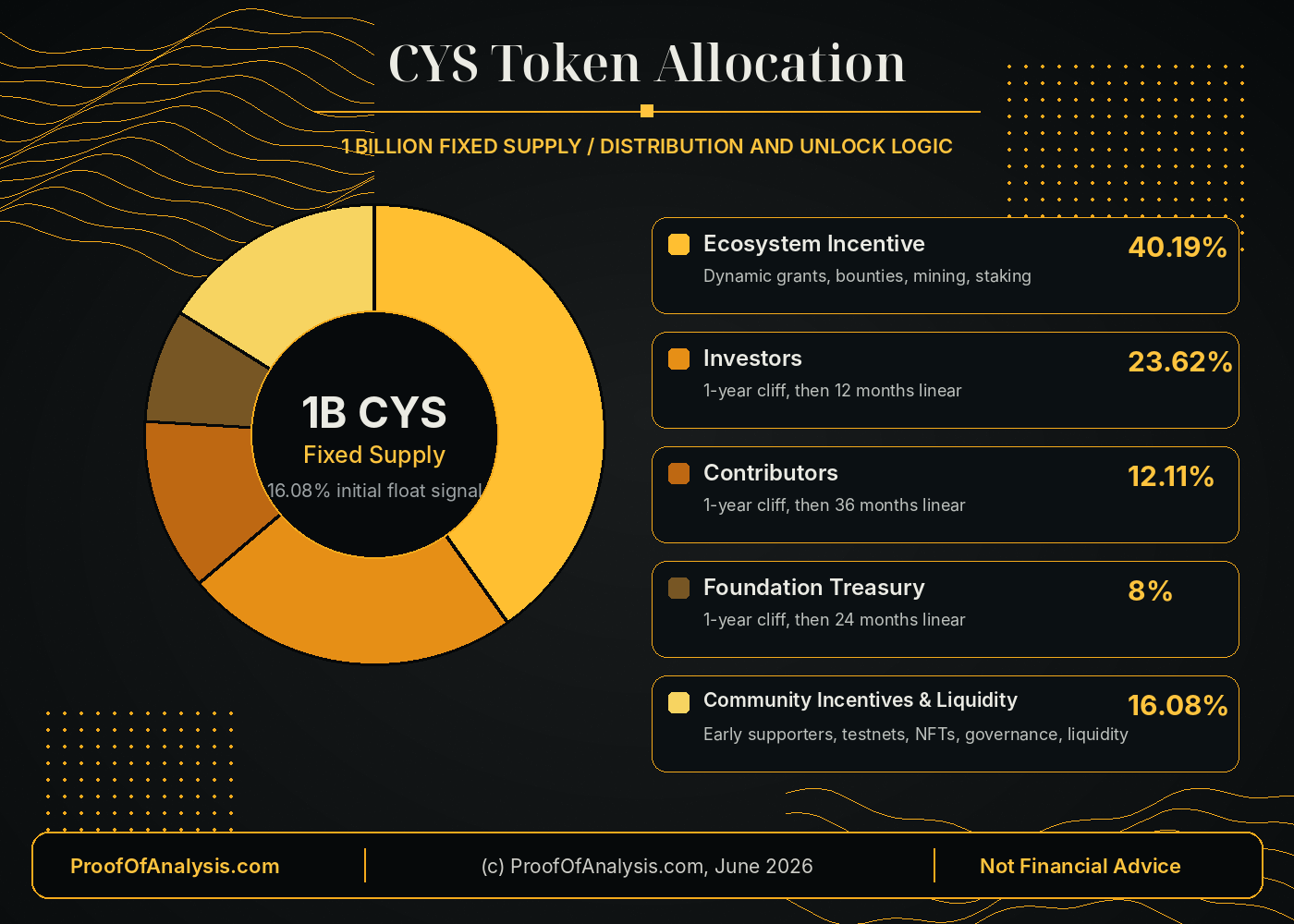
At the time of retrieval, CoinGecko showed exactly 160,800,000 CYS Circulating Supply, which perfectly matches the 16.08% Community Incentives & Liquidity allocation.
The critical unlock block begins roughly one year after TGE, so roughly from December 2026, depending on the exact vesting start. Roughly:
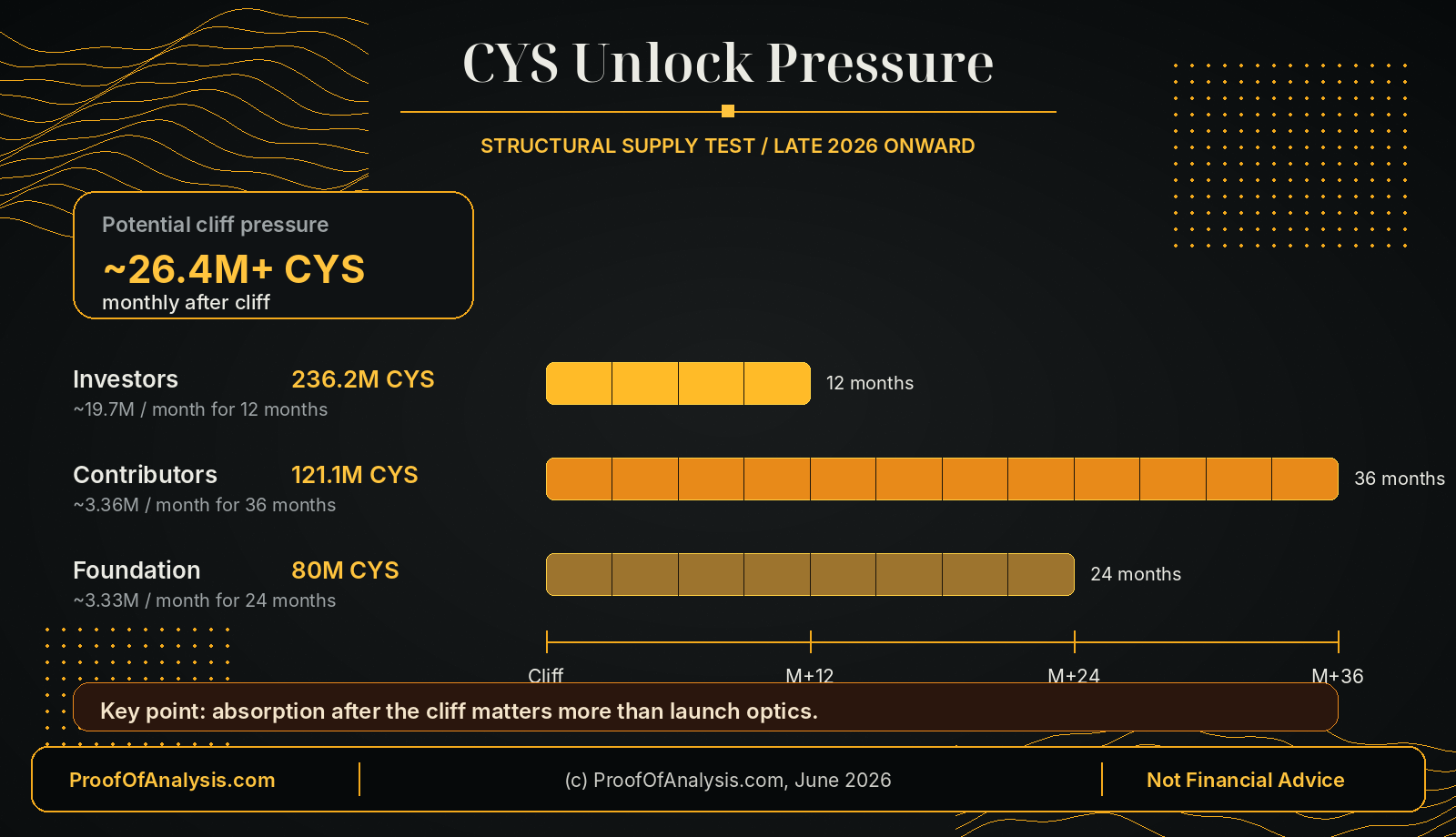
This results in around 26.4M CYS per month starting from the vesting cliff, before dynamic ecosystem emissions are taken into account. Relative to the initial float of 160.8M CYS, this is substantial. Therefore, the most important structural test does not come now, but rather from late 2026 and 2027 onwards.
- Token Utility and Value Accrual
CYS is stronger than many new infrastructure tokens because its utility is relatively directly defined. According to mainnet and tokenomics documents, CYS is used for:
- Payments for ZK proofs, AI inference, and compute services
- Staking in the Proof-of-Compute system
- Rewards for compute contributors and node operators
- Settlement and fee distribution on the L1
- Governance via CGT, which is generated through staking or converting CYS
The strongest point: Compute providers must reserve or stake CYS to execute prover, AI node, or other compute tasks;
prioritization depends on stake and performance according to the docs. More real workloads can therefore lock up CYS.
The weaker point: Rewards also flow in CYS. If providers regularly sell their received CYS, the network constantly needs new demand from task requesters, stakers, verifiers, and governance participants. The token capture is good, but only resilient if the compute market generates real, paying demand. Our value accrual verdict:
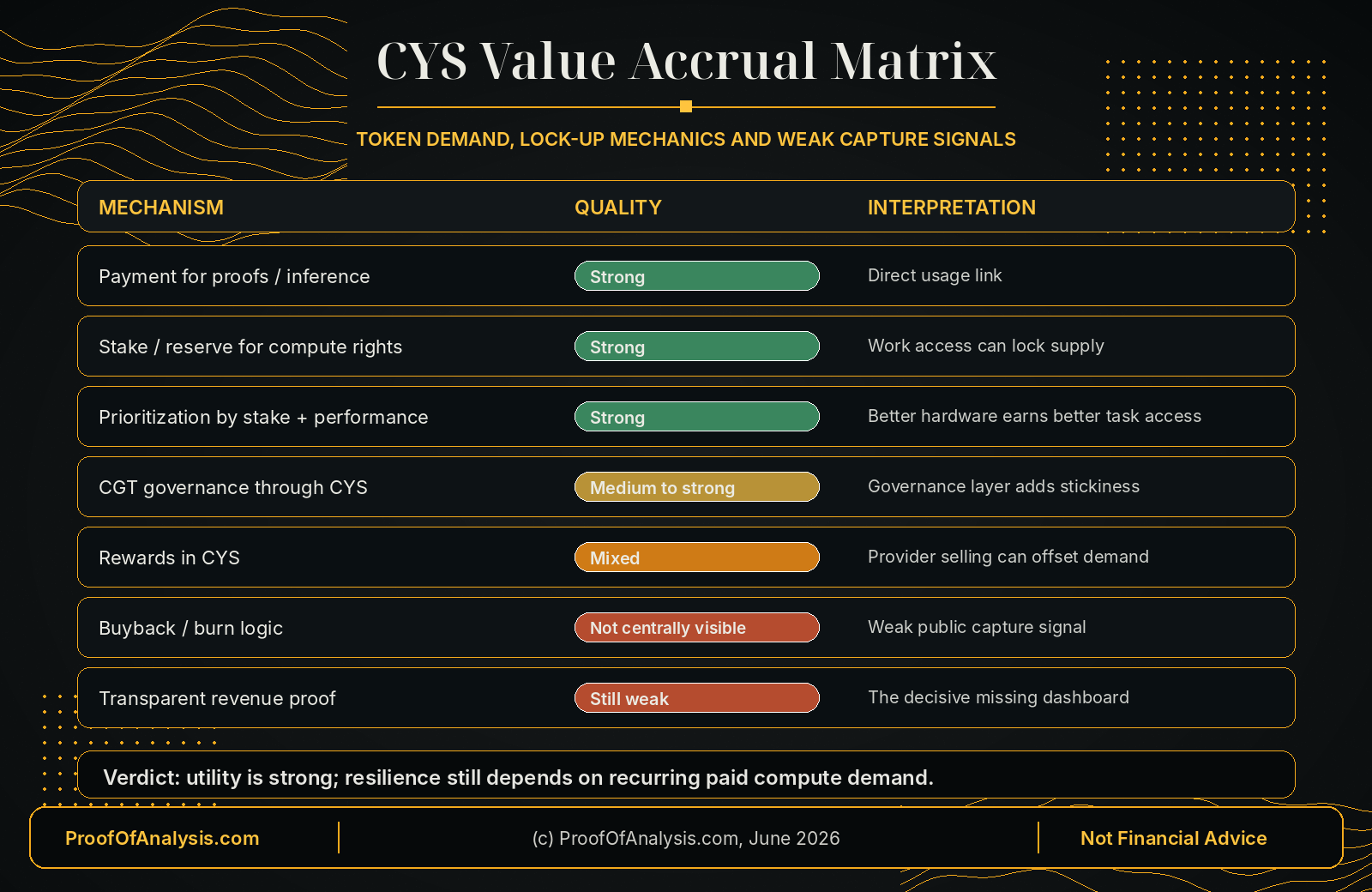
CYS has better utility than ARX and ROBO, roughly on par with OPG, but with a stronger ZK hardware core.
- Market Structure and Valuation
CoinGecko showed approximately at the time of retrieval:
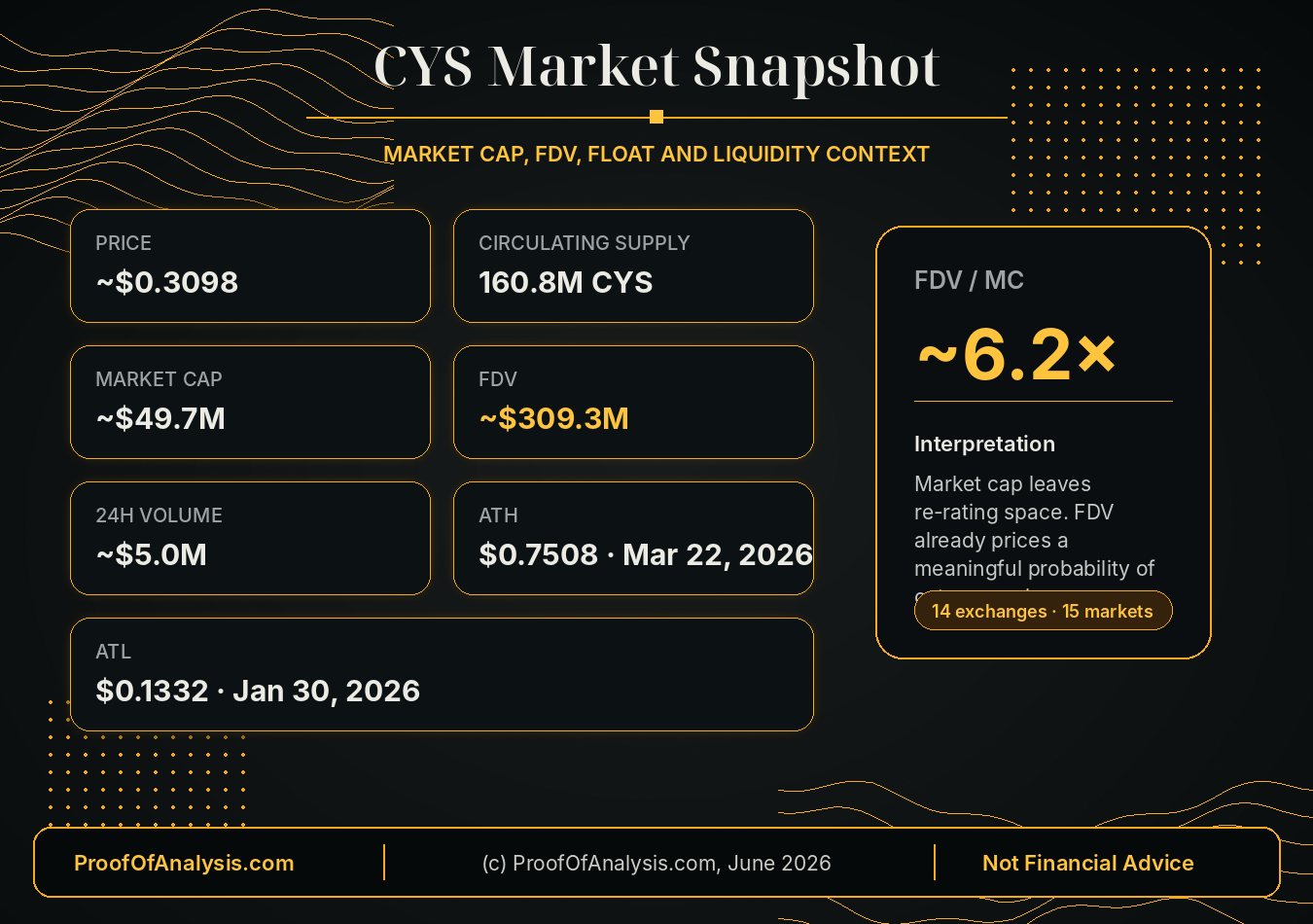
This is neither cheap nor absurd. On a market cap basis, CYS is still small enough for strong re-ratings.
On an FDV basis, it is already a mid-sized infrastructure token. The market is thus already pricing in a certain probability that Cysic will become a relevant verifiable compute player.
Liquidity is usable, but not fully Tier-1. CoinGecko listed 14 exchanges and 15 markets, including PancakeSwap, Gate, Bitget, KuCoin, MEXC, and other markets.
Important: Binance currently treats CYS as a Binance Alpha asset, not as a regular Binance CEX listing. Binance itself writes that CYS can be bought via Binance Alpha and is not directly listed on the Binance Exchange; Binance Alpha also does not imply a subsequent Binance CEX listing.
Additionally, there were Binance Alpha trading competitions and airdrop campaigns. This is good for short-term attention but can distort volume and demand.
- Bull Case
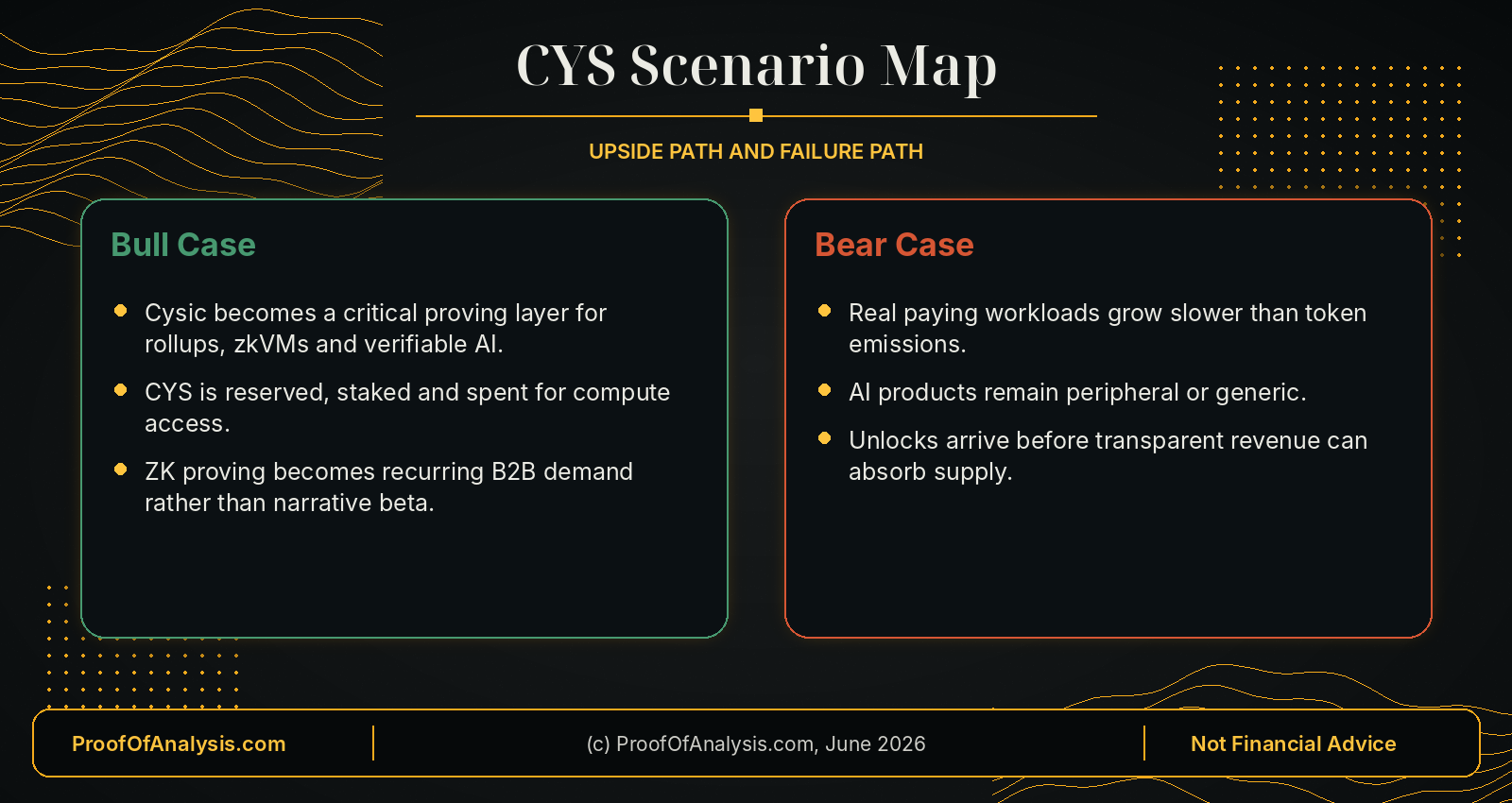
Our bull case is strong:
- Cysic becomes the critical proving and verifiable compute layer for rollups, zkVMs, proof markets, AI inference, scientific workloads, and hardware-bound compute assets.
- ZK proving becomes commonplace in the Ethereum and L2 stack, but proving remains expensive. Cysic delivers acceleration, market coordination, and settlement.
- Providers must stake or reserve CYS, good hardware receives better task priority, proof orders generate CYS flows, CGT governance locks in long-term participants, and CYS evolves into the productive asset of a real compute economy.
- In this scenario, CYS can be valued significantly higher than an ordinary DePIN token because ZK proving has high-quality, paying B2B demand.
- Rollups, bridges, and zkVMs pay for speed, reliability, and cost reduction.
- Bear Case
Our bear case:
- Cysic has strong technology, but the market remains narrower than the story.
- ZK proving gets increasingly serviced by internal teams, specialized cloud providers, or competing proving networks.
- The 260K nodes are partly incentive-driven, and real paying workloads grow slower than token emissions.
- AI products like CyOps, CyClaw, and the Skills Market remain fringe products or generic agent interfaces.
- The token faces noticeable unlock pressure starting in late 2026, while true revenue dashboards are missing.
- Then the project could be technically solid, while CYS as an asset disappoints.
The harshest sentence: Cysic can be a good ZK infrastructure company without CYS automatically becoming an outstanding long-term asset.
- Red Flags
Cysic has published security audits for the token, vesting, bridge, L1 protocol, and NFT contracts by Exvul, which is positive.
At the same time, this does not replace broad production hardening of the entire compute marketplace and the hardware/proving pipeline.
- What We Would Monitor
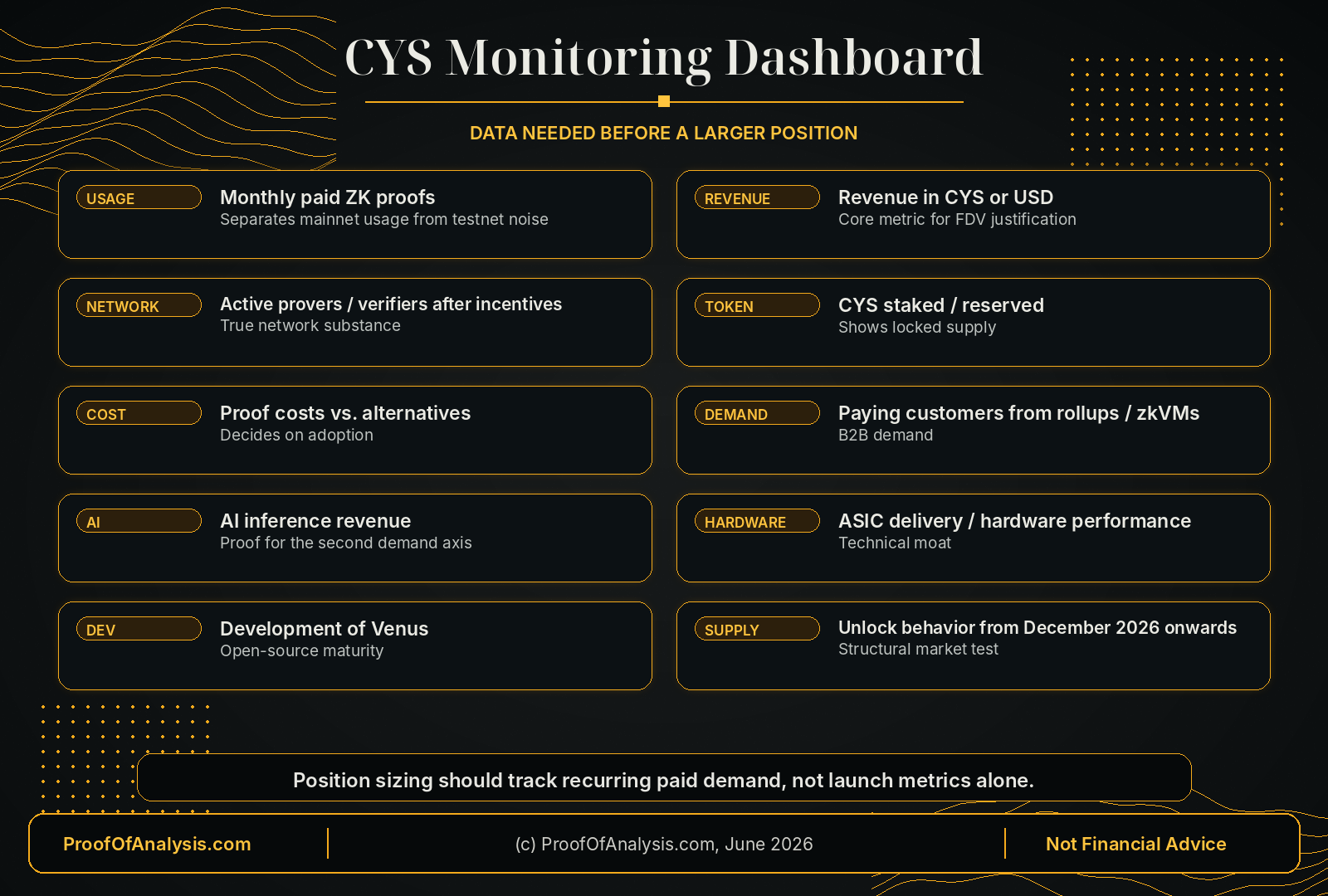
For a larger position, this data would be decisive:
- Investment Conclusion
CYS is a serious watchlist and position candidate. Cysic has real technology, a relevant market problem, good backers, a mainnet, comprehensible token utility, and a better value accrual case than many new AI/DePIN coins.
However, the token is not a sure thing. The valuation on an FDV basis is already substantial. The upcoming unlock profile is demanding. The strong mainnet/testnet numbers must transition into transparent, recurring, paying compute demand. The period before late 2026 will be particularly important: by then, Cysic must show that it has more than good launch metrics, good investors, and a nice ComputeFi narrative.
Our classification:
Watchlist / small to medium scaled position justifiable. Not a blind core-hold.
(June 2026. Not Financial Advice.)